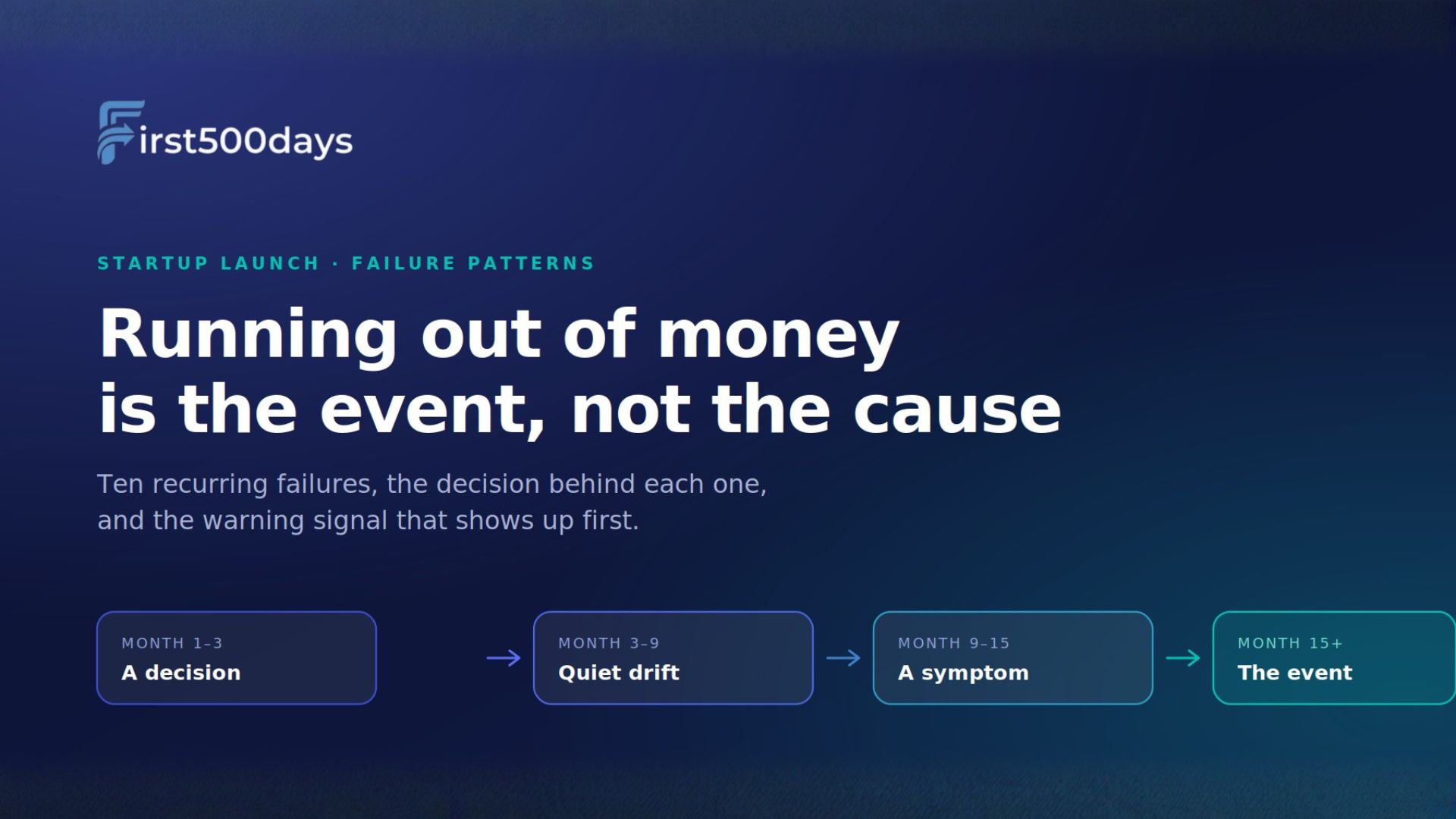
Startups almost never fail from the thing that kills them. They fail from a decision made months earlier, which quietly compounds until the bank balance makes it visible. Here are the ten, each traced back to its origin.
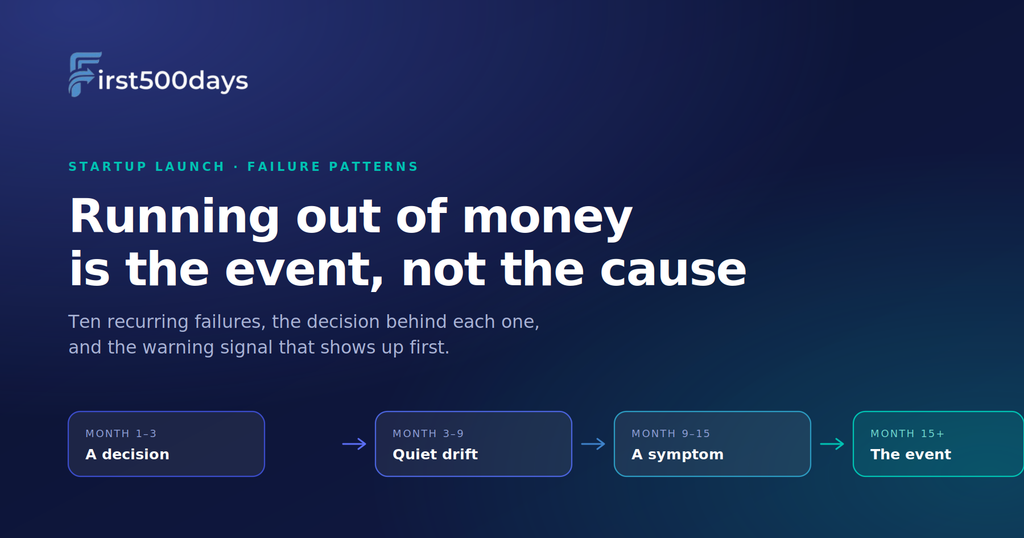
The ten recurring reasons startups fail are: building before validating, no clear business model, weak product–market fit, misreading customer needs, mispriced offerings, delayed go-to-market, the wrong team, absent operational systems, financial planning built backwards, and no outside counsel with standing to say no. Each one is set in motion by a single identifiable decision, and each produces a warning signal long before it becomes fatal.
What follows is not a list of virtues to aspire to. For each failure there is the decision that causes it, the signal that appears first, and the fix — which is nearly always cheaper than the diagnosis suggests, provided you act while the signal is still quiet.
First: the number you keep seeing is probably wrong
“Ninety percent of startups fail” appears on almost every article on this subject and is rarely sourced to anything. The primary data tells a more careful story.
The U.S. Bureau of Labor Statistics tracks survival of new business establishments through its Business Employment Dynamics programme. One-year survival varies by cohort and region — from around 71% for establishments born in 2008 in the South Atlantic division, to about 85% for Pacific-division establishments born in 2021.[1] Most new businesses survive their first year. Failure concentrates later, and it concentrates unevenly.
For venture-backed companies specifically, CB Insights analysed 431 startups that shut down since 2023, identifying causes in 385 of them.[2]
The lag problem
Failure has a delay built into it. The decision is cheap to reverse when it is made and expensive by the time its consequences are legible.
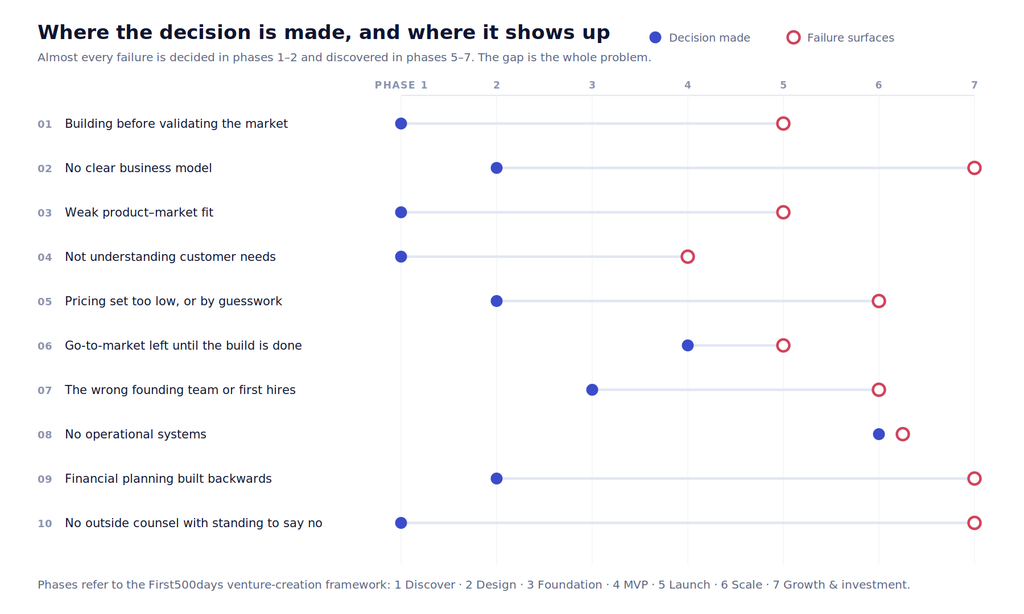
Read the long lines first. A pricing decision made in phase 2 does not announce itself until phase 6, by which time the cost base, the sales motion and the customer expectations have all been built around it. That is why the fixes below are ordered by when to act, not by severity.
The ten reasons
1. Building before validating the market
The decision: starting development because the idea felt obviously right, without twelve conversations that could have proved it wrong.
The first signal: you cannot name a specific person who asked for this. Your reasons for building are all internal — the technology, the gap in the market, the founder’s conviction.
Surfaces: at launch, as silence. Not rejection, which is informative — silence.
The fix: stop and run a two-week validation sprint even mid-build. Founders resist this because it feels like losing two weeks; the alternative is losing the six months already spent plus the six ahead.
2. No clear business model
The decision: treating “how we make money” as something to work out once there is traction.
The first signal: you can describe what the product does in one sentence but need three minutes to explain who pays, how often, and for what.
Surfaces: in the first serious investor conversation, or the first month you need the revenue to actually cover something.
The fix: one page. Who pays, what triggers payment, how often, what it costs you to deliver, what it costs to acquire them. If any line is blank, that is the next thing to work on — not the roadmap.
3. Weak product–market fit
The decision: defining the segment broadly to keep the opportunity large, rather than narrowly enough to build something specific.
The first signal: customers use the product once and do not come back, and every request for a feature comes from a different direction.
Surfaces: at launch, in retention curves that flatten near zero.
The fix: narrow until it hurts. Pick the segment where your existing users are most engaged and rebuild for them specifically. A product loved by a small group beats one tolerated by a large one, because the first can grow and the second cannot.
4. Limited understanding of customer needs
The decision: substituting your own judgement for research, usually because you are close enough to the problem to believe you already know.
The first signal: your roadmap is decided in internal meetings. Nobody in the room has spoken to a customer in the last month.
Surfaces: during MVP build, as scope arguments that cannot be settled because there is no evidence on either side.
The fix: a standing rule that every person who influences the roadmap talks to a customer monthly. It sounds administrative. It changes what gets built.
5. Pricing set too low, or by guesswork
The decision: pricing against your own cost, or against the cheapest competitor, rather than against what it costs the buyer to live with the problem.
The first signal: nobody ever pushes back on your price. A price no one questions is a price set too low.
Surfaces: in phase 6, when gross margin turns out not to cover the cost of acquiring a customer — and by then the price is anchored across the whole customer base.
The fix: raise it for new customers only, and test. Pricing is among the most reversible decisions a company has and is treated as one of the least.
6. Go-to-market left until the build is finished
The decision: sequencing launch after product, on the reasonable-sounding logic that you cannot sell what does not exist.
The first signal: nobody owns distribution. There is a detailed product plan and a marketing plan consisting of the word “launch.”
Surfaces: immediately at launch — a finished product and an audience of nobody, with runway now measured in weeks.
The fix: start building the audience during the build. A waiting list, a newsletter, a design-partner programme — anything that means launch day has people in front of it.
7. The wrong founding team or first hires
The decision: choosing co-founders and early hires for availability and familiarity rather than for the gap they fill.
The first signal: everyone in the company would be a credible candidate for the same job. Nobody disagrees with the founder in a way that changes anything.
Surfaces: in phase 6, when the company needs a capability nobody has and hiring for it is now a nine-month project.
The fix: hire against the bottleneck, not the org chart. And put vesting in place at the start — it is the mechanism that makes a wrong founding-team decision survivable.
8. No operational systems
The decision: keeping everything in the founders’ heads because writing it down feels like bureaucracy at five people.
The first signal: onboarding a new person takes a month of someone’s full attention, and the same questions get answered repeatedly.
Surfaces: the moment you hire past about eight people, and quality becomes inconsistent for reasons nobody can pinpoint.
The fix: document only what you repeat. Not a handbook — the five processes that happen weekly, written once, by the person who does them.
9. Financial planning built backwards
The decision: building the model from a desired outcome and reverse-engineering the assumptions that reach it.
The first signal: the model requires a conversion rate you have never achieved, and the justification is that the current rate is early-stage.
Surfaces: during due diligence, or three months before the money runs out — whichever comes first.
The fix: build the model from measured numbers only. Where you have no measurement, mark the cell as an assumption and state what would need to be true. A model with visible uncertainty is more credible to investors, not less.
10. No outside counsel with standing to say no
The decision: assembling advisors who are supportive rather than useful — friends, investors with small stakes, mentors who meet you quarterly and hear only the summary.
The first signal: no one has told you something you did not want to hear in the last three months.
Surfaces: late, and usually all at once, because every intermediate warning was absorbed by a room that agreed with you.
The fix: one person, with real experience, explicitly asked to disagree, meeting monthly with access to the actual numbers. The value is entirely in the standing to be blunt.
All ten, in one table
| Failure | Decided in | The first signal | Surfaces |
|---|---|---|---|
| Building before validating | Phase 1 | No named person asked for it | Phase 5 |
| No clear business model | Phase 2 | Three minutes to explain who pays | Phase 7 |
| Weak product–market fit | Phase 1 | Users try it once | Phase 5 |
| Misreading customer needs | Phase 1 | Roadmap set in internal meetings | Phase 4 |
| Mispriced offering | Phase 2 | Nobody questions the price | Phase 6 |
| Delayed go-to-market | Phase 4 | Nobody owns distribution | Phase 5 |
| Wrong team or first hires | Phase 3 | Everyone could do the same job | Phase 6 |
| No operational systems | Phase 6 | Onboarding eats a month | Phase 6 |
| Financial planning backwards | Phase 2 | Model needs an unachieved rate | Phase 7 |
| No dissenting counsel | Phase 1 | Nobody has disagreed in months | Phase 7 |
The three that do most of the damage
They are not equally weighted. Three of the ten account for a disproportionate share of what we see go wrong.
Building before validating (1) is the most expensive because it invalidates everything downstream. You can recover from bad pricing on a product people want. You cannot price your way out of a product nobody needs.
Pricing (5) is the most under-rated, because it is invisible while revenue is growing. A company that has priced 40% too low looks healthy right up until it needs to fund acquisition out of gross margin.
No dissenting counsel (10) is the multiplier. Every other failure on this list is survivable if somebody names it out loud in month four. Without that, each one runs its full course.
Most failures are not decisions nobody questioned. They are decisions nobody was in a position to question.
Run a pre-mortem instead of a post-mortem
Post-mortems are written by companies that no longer exist. The same exercise, run in advance, is one of the cheapest diagnostic tools available — and it works because it removes the social cost of raising a concern.
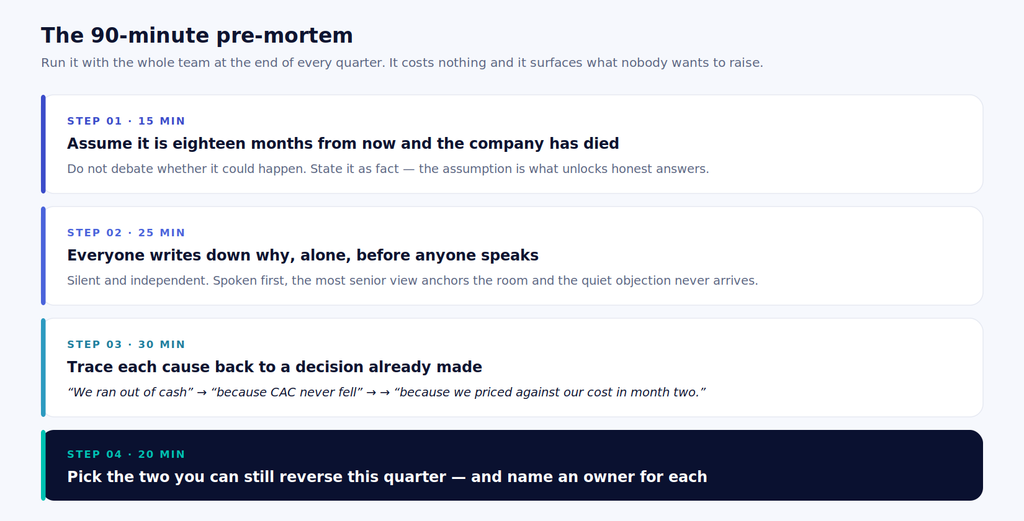
Founders consistently report that the pre-mortem surfaces concerns the team had already privately formed but had no comfortable way to raise. That is the mechanism. You are not generating new insight — you are creating permission for insight that already exists in the room.