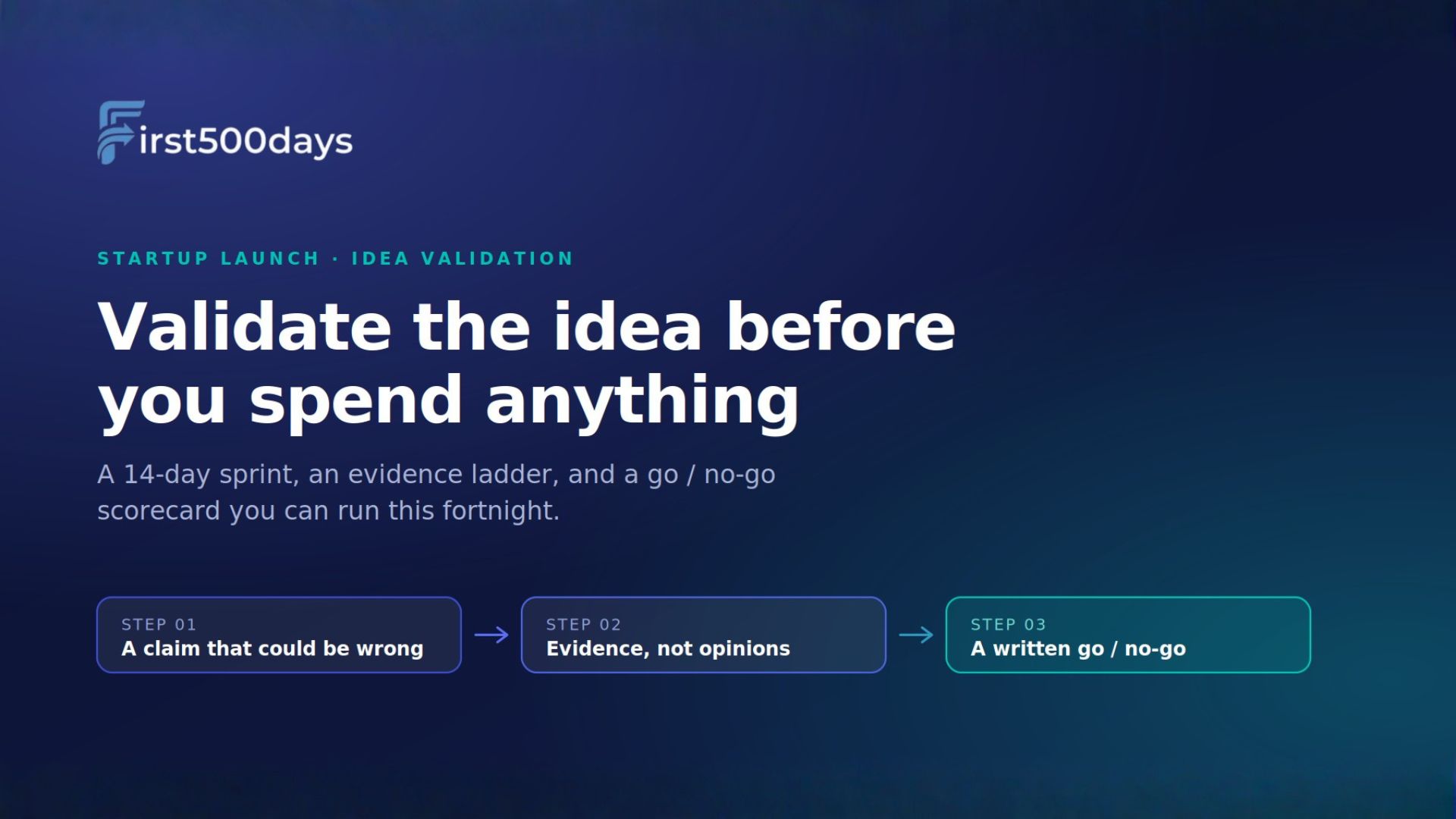
Validation is not asking friends whether they like your idea. It is a structured hunt for evidence that would prove you wrong and it takes about two weeks and no money at all.
To validate a business idea, write down a claim that could be proven false, have twelve conversations with people who have the problem about what they already did, look for evidence stronger than an opinion — existing spend, committed time or a prepayment — then score what you found and write down a go or no-go decision. Two weeks. No product, no budget, no designer.
Most founders skip this, not out of laziness but because building feels like progress and asking feels like delay. The cost arrives later: CB Insights, analysing 431 venture-backed companies that shut down since 2023, found poor product–market fit cited in 43% of the failures with an identifiable cause.[1] That is a validation problem showing up eighteen months late, wearing a cash-flow costume.
What does it mean to validate a business idea?
Validating a business idea means gathering evidence that a specific group of people has a problem they already spend time or money trying to solve, and that they would plausibly pay you to solve it better. It is not proof that your business will work. It is proof that the problem is real, the buyer is reachable, and the arithmetic could work.
Three things separate real validation from the comfortable version:
- It can fail. If no outcome of your research would stop you building, you are not validating — you are collecting encouragement.
- It is about the past. What someone did last month is data. What they say they would do next year is imagination, and imagination is generous.
- It ends in a decision. Written down, dated, with the reasoning. Otherwise you will relitigate it every time something goes wrong.
Why validation usually fails when founders run it themselves
Not because founders are dishonest — because the incentives are brutal. You have told people about this idea. You may have left a job for it. Wanting a particular answer contaminates the questions.
Four specific failure modes show up again and again:
Leading the witness. “Would you use a tool that saves you three hours a week?” is not a question, it is a pitch with a question mark. Nobody says no to saved time in the abstract.
Talking to the wrong people. Friends, ex-colleagues and other founders are easy to reach and structurally unable to help. They will be kind, and kindness is the enemy here.
Confusing interest with intent. “Send me a demo when it’s ready” is a polite exit, not a sales signal. Rob Fitzpatrick’s The Mom Test makes the point well: ask questions even your mother could not answer with false encouragement.
Stopping at the first yes. One enthusiastic buyer is a coincidence. The pattern only appears somewhere between conversation eight and twelve, which is exactly when most founders decide they have heard enough.
If every conversation confirms your hypothesis, you are asking the wrong questions — or the wrong people.
The evidence ladder: what actually counts as proof
Not all evidence is equal, and treating it as though it were is how founders build the wrong thing with total confidence. Rank what you hear.
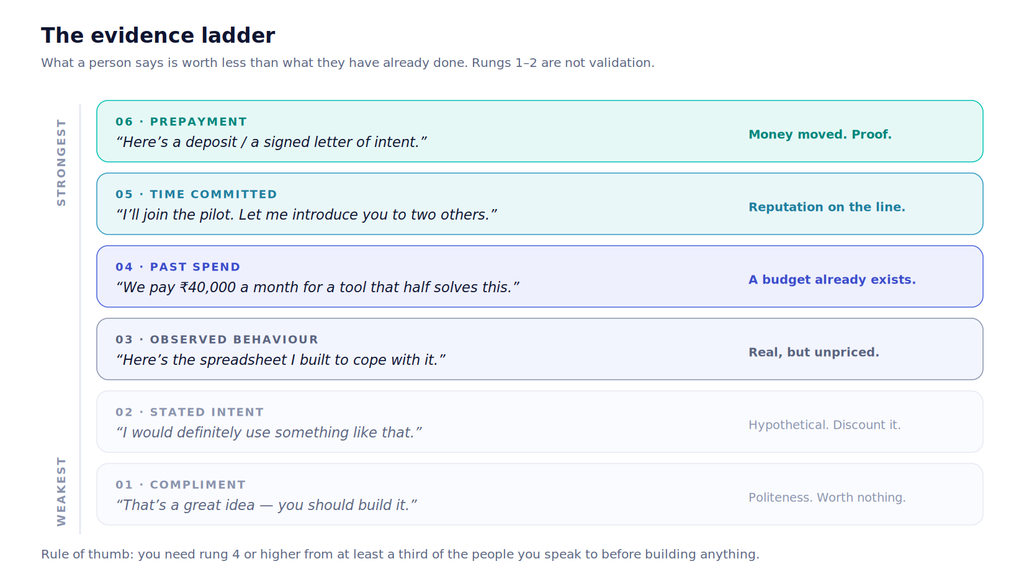
The practical rule: you need rung 4 or higher from at least a third of the people you speak to before building anything. Twelve conversations, four or more of which surface an existing budget, a committed pilot or a prepayment. Below that, the problem may be real but not urgent — and non-urgent problems do not get purchase orders.
Notice what the top three rungs have in common: the other person gives something up. Money, time, or reputation by making an introduction. Costless enthusiasm is not evidence, however sincerely it is offered.
The 14-day validation sprint
Two weeks is deliberate. Long enough to reach twelve people, short enough that you cannot start designing screens while you wait.
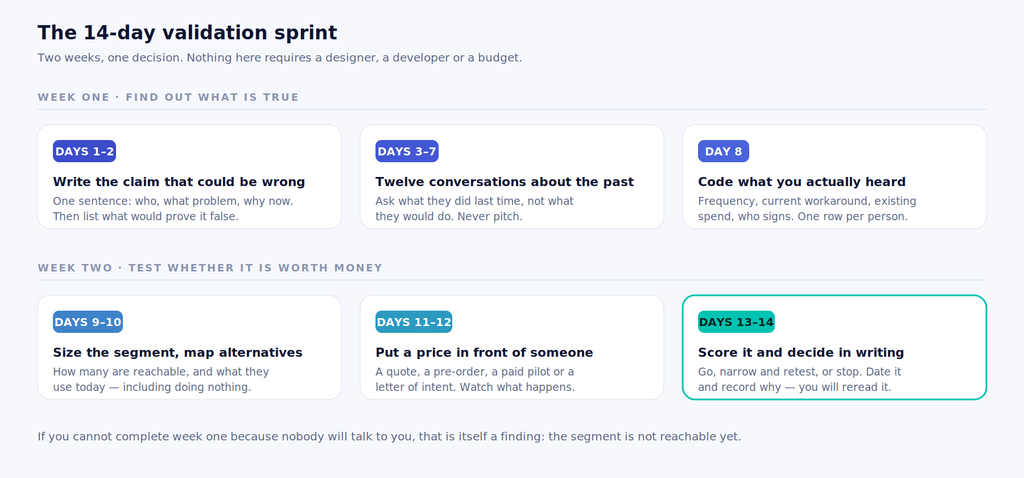
Days 1–2 — Write the claim that could be wrong
One sentence, specific enough to be falsified: “Independent physiotherapy clinics in Tier-1 Indian cities lose revenue to no-shows, and already pay for at least one tool that fails to prevent them.” Not “there is an opportunity in healthcare scheduling.”
Then write, underneath it, the three findings that would kill it. If you cannot name them, the claim is too vague to test.
Days 3–7 — Twelve conversations about the past
Target people who have the problem now, not people who resemble them. Twelve is not arbitrary: below eight you are hearing noise, and past fifteen the returns fall off sharply unless you have changed segment.
Ask about history, not hypotheses:
| Ask this | Not this | Why |
|---|---|---|
| “Walk me through the last time this happened.” | “How often does this happen?” | Specific memory beats estimated averages |
| “What did you do about it?” | “What would you want to do?” | Behaviour is data; preference is not |
| “What does that cost you today?” | “Would you pay for a fix?” | Reveals the budget that already exists |
| “Who else had to be involved?” | “Would your boss approve it?” | Uncovers the real buying process |
| “What have you already tried?” | “Do you like this idea?” | Shows effort already spent, and why it failed |
| “Who else should I be speaking to?” | “Shall I send you a demo?” | An introduction is rung-5 evidence |
Do not pitch. The moment you describe your solution, the conversation stops producing information and starts producing politeness. If you must, describe it in the last two minutes, after everything useful has been said.
Day 8 — Code what you actually heard
One row per person in a spreadsheet, with columns for: how often the problem occurs, what they do about it today, what that currently costs, who signs off on a purchase, and which rung of the evidence ladder they reached.
This step is where self-deception dies. Impressions blur together and reliably drift optimistic; a table does not. When you see that ten of twelve people reached only rung 2, you know something you did not know on day 7.
Days 9–10 — Size the segment and map the alternatives
Two questions. First: could you find another hundred of these people within a month, and by what route — a directory, an association, a conference list, a search term? A segment you cannot reach systematically is not yet a market, whatever its size.
Second: what do they use today? Include the two alternatives founders forget — a spreadsheet, and doing nothing. “Do nothing” wins more deals than any competitor, and it is free.
Days 11–12 — Put a price in front of someone
Willingness to pay cannot be surveyed. It has to be provoked. Options, in ascending order of usefulness:
- A written quote for work you would do manually, at a real price.
- A paid pilot — small, but paid. A free pilot tells you nothing.
- A pre-order or deposit against future delivery.
- A letter of intent naming scope, price and a date.
Watch what happens when the number appears. The reaction — a flinch, a counteroffer, a request to involve someone else — is more informative than anything said in the previous hour.
Days 13–14 — Score it and decide in writing
Score against fixed criteria rather than the memory of your best conversation, then write the decision down with the reasoning and the date.
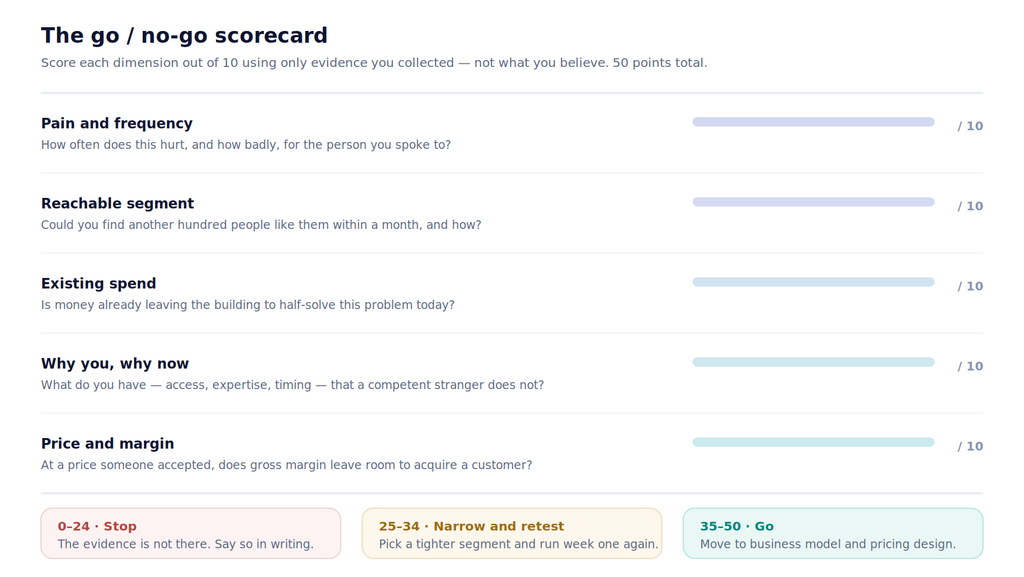
The middle band matters most. A score in the twenties or low thirties usually means the problem is real but the segment is too broad — not that the idea is dead. Narrowing and rerunning week one is a week of work; discovering it at day 300 is a year.
What validation cannot tell you
Honesty about the limits keeps you from over-trusting the result.
- Whether people will use it. Buying and using are different behaviours, and only a real product tests the second.
- Whether you can build it profitably. That is business-model work, and it comes next.
- Whether the market is big enough. Twelve conversations establish that a problem exists, not that it exists at scale.
- Whether you can win. Distribution, timing and competitive response are outside what a two-week sprint can see.
What it does tell you is whether to spend the next six months and a chunk of your savings. That is enough to justify the fortnight.
Validating in a market you do not live in
Founders validating for a country they have never worked in face two extra problems, and both are solvable.
You cannot read the signals. Politeness norms differ sharply. In some markets a soft “we’ll consider it” is a firm no; in others, directness that would be rude at home is simply how business is done. Interpret with someone local in the room.
Your network does not reach the buyer. The route in is usually an association, a trade body, a regional accelerator or a distribution partner — not cold outreach, which converts poorly across borders and cultures.
The sprint itself does not change. What changes is who makes the introductions and who helps you read the answers — which is one reason market-entry validation is normally run with people on the ground rather than from a desk two time zones away.
Six mistakes that waste the fortnight
- Surveys instead of conversations. A survey gives you the answers to questions you already thought of. The value is in what you did not think to ask.
- A landing page as validation. Email signups measure copywriting. They are a useful supplement, never the primary evidence.
- Counting your own excitement. Conviction is necessary to build and useless as evidence.
- Validating the solution, not the problem. People will happily critique your feature list. That tells you nothing about whether they would buy anything at all.
- Treating a pivot as failure. Most successful validation sprints change the segment, the problem, or both. That is the sprint working.
- Never writing the decision down. Undocumented decisions get re-argued at every setback, usually at the worst moment.