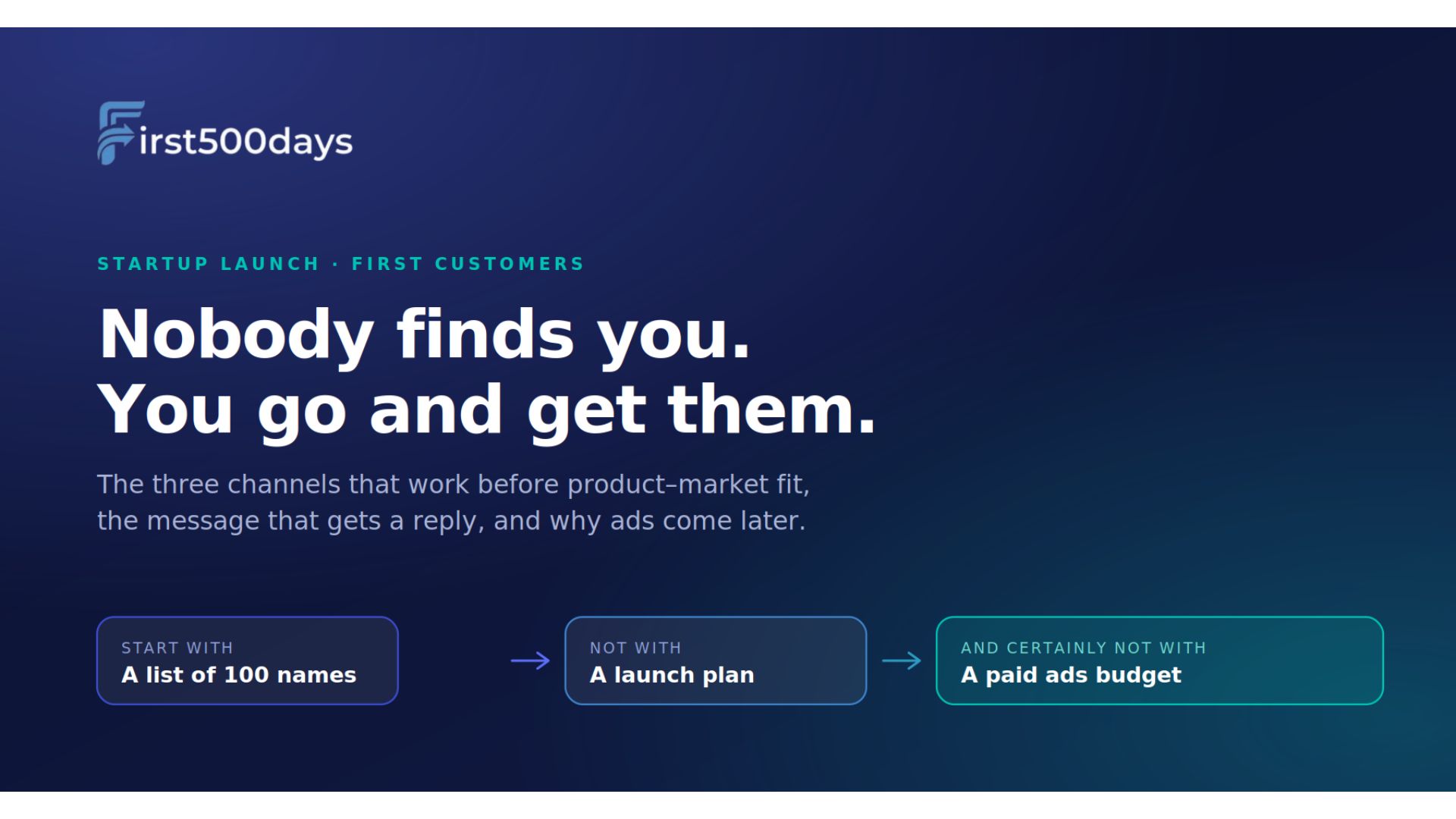
There is no clever channel. The first ten come from a list of names you researched one at a time, a message that proves you are writing to them specifically, and about a hundred hours of work. Here is exactly how that goes.
To get your first ten customers: build a list of a hundred named people who have the problem, write to each one individually with a specific reference to them, ask for twenty minutes rather than a sale, and expect roughly 28 replies, 18 conversations and 10 customers from it. Warm introductions from those conversations will outperform everything else. Paid advertising, SEO and PR do not work yet, and the reason is structural rather than tactical.
Paul Graham put the underlying point plainly in 2013: “You can’t wait for users to come to you. You have to go out and get them”, and “the most common unscalable thing founders have to do at the start is to recruit users manually.”[1] That was true before every growth tool existed and it is still true now.
Why the clever channel does not exist
Founders spend an enormous amount of energy looking for a way around the manual work. The search is understandable — outreach is uncomfortable and slow — but the arithmetic is against it.
Every scalable channel is an amplifier. Paid ads amplify a funnel that already converts. SEO amplifies content that already answers a question people are searching for. Partnerships amplify a sales motion that already closes. Before product–market fit you have none of those things, so amplification has nothing to work with. You are paying to discover, at scale, that the thing does not yet convert.Three channels that work now, four that work laterThe difference is not effectiveness. It is that the right-hand column needs a funnel that already converts — and you do not have one yet.✓ WORKS BEFORE PRODUCT–MARKET FIT01 · Direct outreach to a named listYou know exactly who has the problem, so you write tothem individually. One hundred names, researched, nota bought list. This is the whole game at the start.EXPECT: 20–35% reply if genuinely personal02 · Warm introductionsEvery conversation ends with “who else should I speakto?” An introduction converts several times better thana cold approach and costs one sentence to ask for.EXPECT: your best channel for the first ten03 · Where the problem is already discussedIndustry groups, forums, associations, events, subreddits,WhatsApp and Slack communities. Be useful for weeksbefore you mention what you built.EXPECT: slow, compounding, high trust✗ NOT YETPaid advertisingMakes a working funnel bigger. It does notmake a broken one work — it just finds outfaster, and charges you for the privilege.SEO and contentWorks, and takes six to twelve months. Startit now, expect nothing from it for the firstten customers.PR and launch platformsA spike of the wrong traffic. Memorable forthe founder, rarely visible in revenue amonth later.Partnerships and resellersNobody will sell a product you cannot yetsell yourself. Revisit once the motion works.Three channels that work now, four that work later. The right-hand column is not wrong — it is early.
There is a second reason the manual approach wins at this stage, and it matters more than the first. Every one of those hundred messages and eighteen conversations is research. You learn which framing lands, which segment responds, what objection recurs, and what people call the problem when they describe it themselves. An ad campaign gives you a click-through rate. A conversation gives you the sentence that will eventually go on your homepage.
Manual outreach is not the cheap version of marketing. It is the research phase of marketing, and it happens to produce revenue.
Step one: build the list of a hundred
Not a purchased list. A hundred named individuals, each of whom you have a reason to believe has this problem right now.
Where they come from depends on the market, but the productive sources are consistent: industry associations and their member directories, conference attendee and speaker lists, people who have posted publicly about the problem, LinkedIn searches by role and company type, review sites for the tool they currently use, and local business registries for geography-specific products.
Three rules make the difference between a list that converts and one that does not:
- One segment only. A hundred people who look like each other. Mixed lists produce mixed messages and teach you nothing about which group responds.
- A note per person. One line on why you chose them — what they posted, what they use, what changed at their company. If you cannot write that line, they do not belong on the list.
- The person, not the company. Companies do not reply to emails. Find the individual whose week is worse because of this problem.
Building this takes six to ten hours. It is the least glamorous work in the first 500 days and the highest-leverage.
Step two: the message
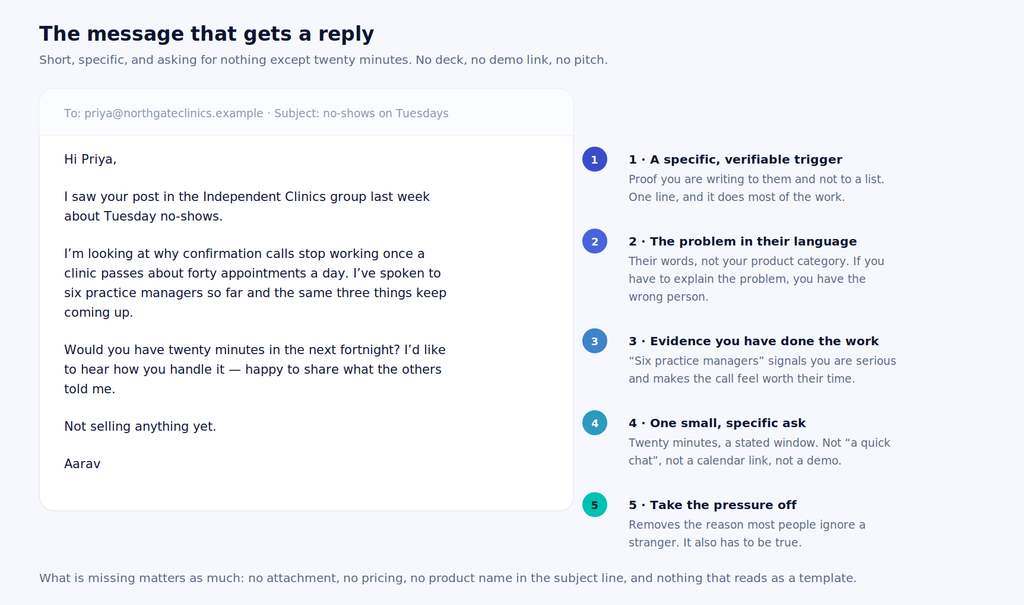
The ask is the part founders get wrong most often. “Can I show you what we’ve built?” asks the recipient to evaluate you, which is work. “Would you have twenty minutes to tell me how you handle this?” asks them to talk about their own problem to someone who has clearly done their homework, which is comparatively pleasant.
On follow-ups: two, spaced about five and twelve days after the first, each adding something rather than repeating. A relevant article, a finding from another conversation, a short observation. Then stop. Most replies to a genuinely personal message arrive on the first or second attempt.
Step three: the conversation
The single most common mistake is treating a first conversation as a demo. It is not. It is the same discovery conversation from validation, with one difference: at the end, if the problem is real and urgent, you ask.
A workable structure for twenty minutes:
- Two minutes: thank them, restate why you got in touch, confirm you are here to listen.
- Twelve minutes: their situation. What happens today, what it costs, what they have tried, who else is involved. Ask about the last specific time it happened.
- Four minutes: if — and only if — they have described a real, expensive, recurring problem, tell them briefly what you are building and ask whether they would like to be one of the first to try it.
- Two minutes: next step with a date, and the question that keeps the pipeline alive: “who else should I be speaking to?”
That last question is the one that compounds. Introductions convert several times better than cold approaches, and every conversation can produce one or two. Ten cold conversations properly handled will generate enough warm ones to reach your first ten customers.
What the funnel actually looks like
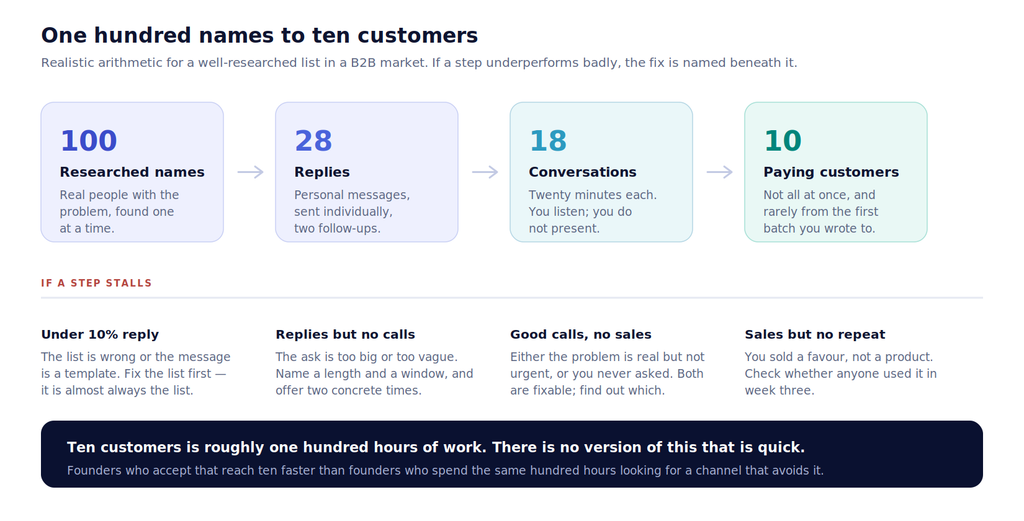
The diagnostic that matters most is the first one. A reply rate below 10% almost always means the list is wrong rather than the message — you have written well to people who do not have the problem. Founders reliably rewrite the message five times before questioning the list, which is the wrong order.
Asking for money
The hardest sentence in the first 500 days is the one where you name a price to someone who has been generous with their time. Three things make it easier and better.
Charge from the first customer. A free pilot proves someone will accept something free. Even a small amount converts a favour into a transaction, and transactions produce honest feedback in a way favours never do.
Ask directly and then be quiet. “It’s £400 a month. Would you like to start in the first week of next month?” Then stop talking. The pause is uncomfortable for about four seconds and it is where the answer comes from.
Treat a no as data. Ask what would have needed to be different. The answer is worth more than the sale, and people who have just declined are unusually honest.
Early customers are not the same as early adopters
The people who say yes first are not a random sample. They tend to be more tolerant of rough edges, more motivated by the problem, and more willing to work around gaps. That makes them excellent design partners and unreliable evidence of mainstream demand. Learn from them, but do not conclude the market is solved because ten enthusiasts said yes.
What to do while you wait
Outreach has dead time built in, and it is the best window you will get for the slow-burning channels. Start the SEO and content work now — not because it will produce customers in the next ninety days, but because it takes six to twelve months to produce anything and starting it later just delays that.
The same applies to communities. Turning up in a forum the week you need customers is transparent. Turning up six months earlier, answering questions and being useful, means that by the time you mention what you built, you are a known participant rather than an intrusion.
Six mistakes that cost the most time
- Automating the outreach. A sequencing tool turns a personal message into an obvious template, and the reply rate collapses. Send the first hundred by hand.
- Leading with the product. Nobody has a product-shaped problem. They have a Tuesday-afternoon-shaped problem.
- Building a landing page and waiting. A page with no traffic is a page nobody sees. Distribution is the work; the page is a supporting document.
- Discounting to close the first deal. Those customers become your reference price and your case studies. Discount the scope instead, never the rate.
- Not asking for introductions. The cheapest, highest-converting channel available, and it costs one sentence at the end of a call you were having anyway.
- Stopping at ten. Ten customers is the beginning of the search for a repeatable motion, not the end of it. Keep going until you can predict what a week of outreach produces.