The question is badly framed, and the framing is what makes European entries expensive. Selling is a bloc-level decision. Hiring is a country-level decision. Most companies get these the wrong way round.
General information, not tax or legal advice
The EU-level rules below are sourced to the European Commission, the Your Europe portal and the GDPR itself, and linked at the end. Everything national — company law, corporate tax, employment law, sector licensing — varies by country and is deliberately not summarised here. Take local advice before acting.
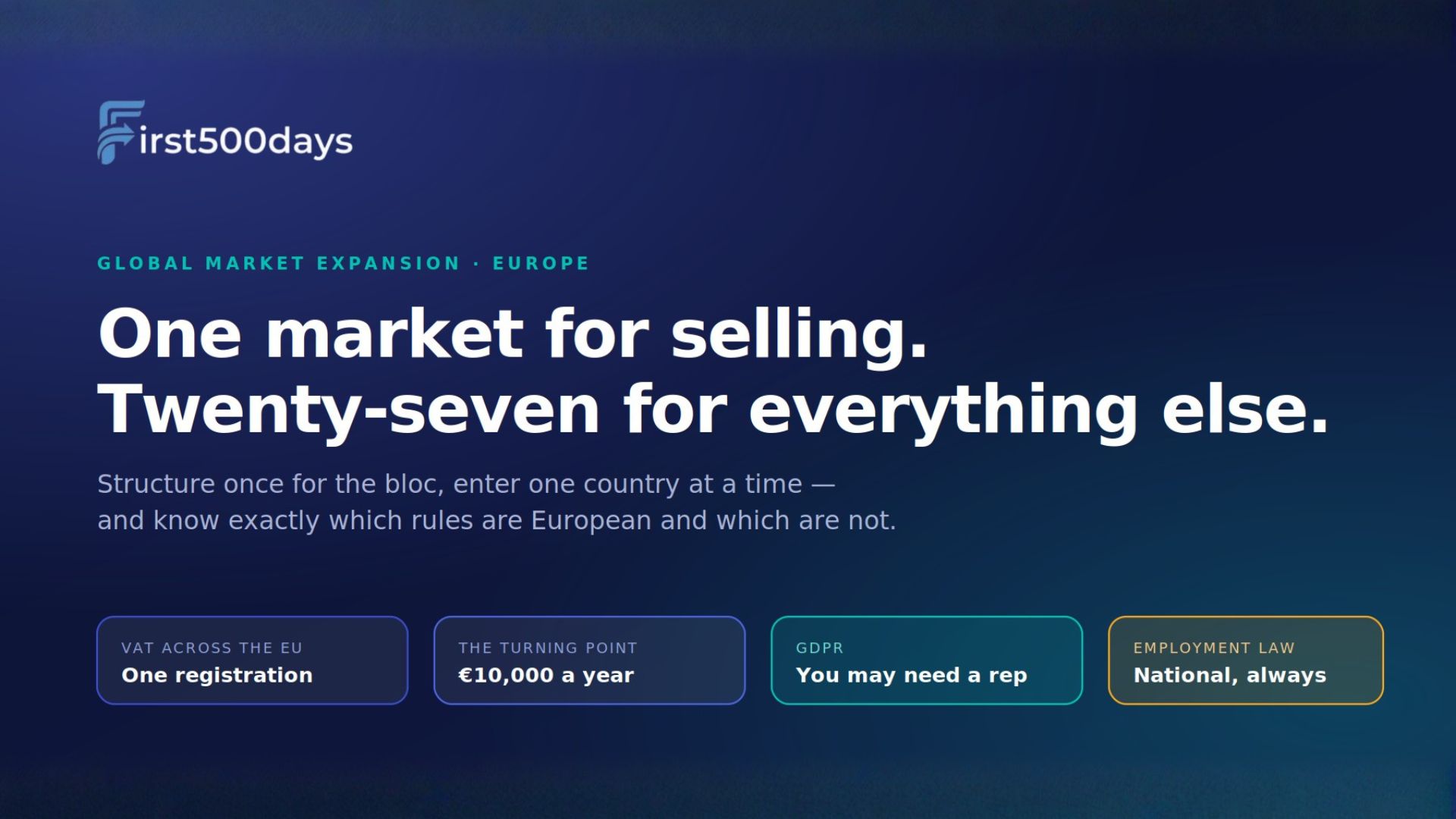
Enter one country at a time for go-to-market, and structure once for the bloc. A single entity can sell across the whole EU, and cross-border consumer VAT can be declared through one registration using the One Stop Shop. What does not travel is everything national: company law, corporate tax, employment law and sector rules. So sell everywhere, hire in one place, and only add the second country when the first one runs without you.
What is European, and what only looks European
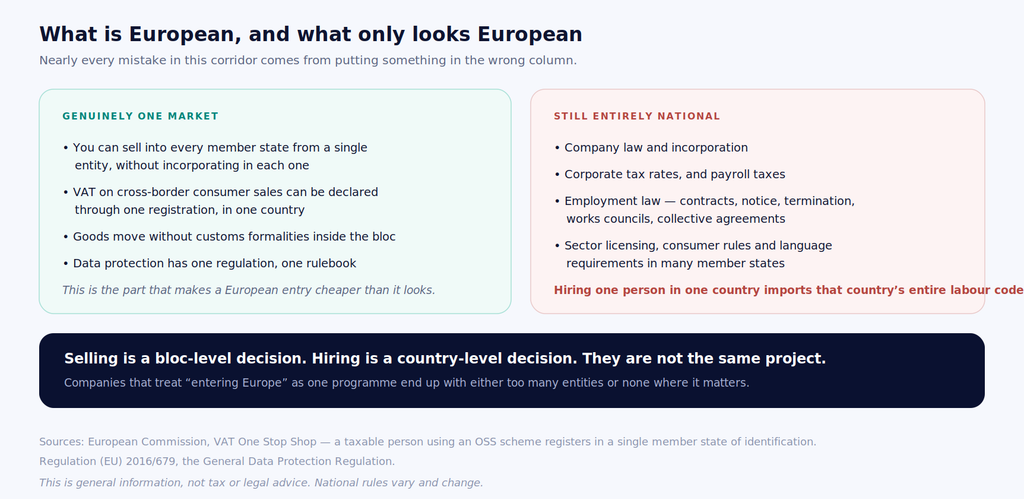
The single market is real, and it is more useful to a foreign company than most people entering it realise. You do not need an entity in each member state to sell into it. Goods move inside the bloc without customs formalities. Data protection has one regulation rather than twenty-seven. And — the big one for anyone selling to consumers — cross-border VAT can be handled through a single registration.[1]
What is not European is the part founders assume is. Company law is national. Corporate tax rates are national and vary enormously. Sector licensing is national. And employment law is emphatically national: contracts, notice periods, termination, works councils, collective agreements. Hiring one person in one country imports that country’s entire labour code into your business, and European labour codes are considerably harder to reverse out of than the ones most founders are used to.
You can sell to twenty-seven countries from one company. You cannot employ in twenty-seven countries from one company and expect the same simplicity.
The VAT rule that decides how complicated this gets
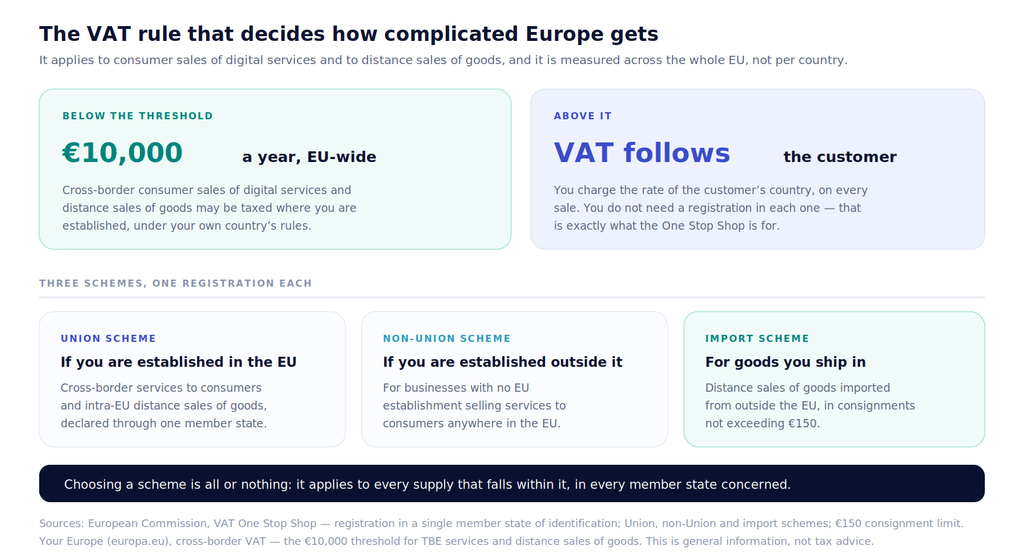
For cross-border consumer sales — telecommunications, broadcasting and electronic services, and distance sales of goods — there is a single EU-wide threshold of €10,000 a year. Below it, those supplies may be taxed where you are established, under your own country’s rules. Above it, VAT follows the customer: you charge the rate of the customer’s country.[2]
That sounds like twenty-seven registrations, and it is not, because the One Stop Shop exists precisely to prevent that. A business using an OSS scheme registers in one member state of identification and declares VAT for every member state of consumption through it.[1] Three schemes cover the cases:
- Union scheme — for businesses established in the EU, covering cross-border services to consumers and intra-EU distance sales of goods.
- Non-Union scheme — for businesses with no EU establishment supplying services to consumers in the EU.
- Import scheme — for distance sales of goods imported from outside the EU, in consignments not exceeding €150.[1]
One important condition: opting into a scheme is all or nothing. It applies to every supply falling within that scheme in every relevant member state, not to the countries you find convenient.[1]
Two things this does not cover, and both catch people. B2B sales work differently — the reverse charge mechanism usually shifts the obligation to your business customer, which is simpler but has its own evidence requirements. And holding stock in a member state, for example in a fulfilment warehouse, generally creates a local registration obligation that the OSS does not solve. If you are shipping physical goods and using third-party fulfilment, get that specific question answered before you sign the warehouse contract.
GDPR, in the two sentences that actually matter to you
Most GDPR content is written for companies that already operate in Europe. The two provisions that matter when you are entering are narrower.
First: if you are not established in the Union but you offer goods or services to people in it, or monitor their behaviour, you generally must designate a representative in the Union. The exemptions are narrow — occasional processing that is unlikely to result in a risk to people’s rights, and public authorities.[3] A representative is a real appointment with a real address, not a line in a privacy policy.
Second: once you do have an establishment in the EU, the lead supervisory authority mechanism means you deal primarily with one country’s regulator rather than all of them — which is a genuine argument for putting your EU establishment somewhere you are comfortable being regulated from.
Everything else — lawful basis, transfers, retention, subject rights — is the ordinary work of running a compliant product, and it is cheaper to build in than to bolt on. If your product already meets a serious standard, Europe is less frightening than its reputation. If it does not, Europe will be where you find out.
So: one at a time, or the whole bloc?
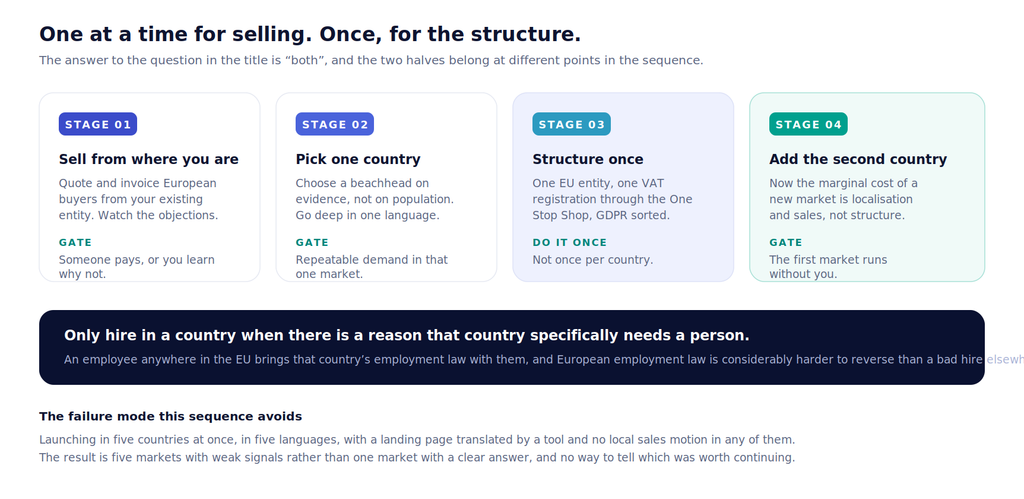
The failure mode we see most often is a launch across five countries at once, in five languages, with a translated landing page and no local sales motion anywhere. It produces five weak signals rather than one clear answer, and nothing to tell you which market was worth continuing.
The opposite failure is treating each country as a fresh structural project — a new entity, a new VAT registration, a new accountant — when the bloc-level tools would have covered all of them.
The sequence that avoids both: sell into Europe from where you already are and see who responds. Pick one beachhead country on that evidence rather than on population. Structure once — one EU entity if you need one, one OSS registration, GDPR handled properly. Then add a second country when the first is repeatable, at which point the marginal cost of a new market is localisation and sales rather than structure.
Choosing the beachhead
Population is the worst criterion and the most commonly used. Better ones:
- Where your inbound is already coming from. The cheapest signal available, and most companies have it and ignore it.
- Where you can sell in a language you already operate in. Ireland and the Netherlands are frequently chosen for this reason, and the Nordics conduct a great deal of business in English.
- Where your buyer type concentrates. Manufacturing, financial services, logistics and public sector cluster very differently across Europe.
- Where the sales cycle is shortest. Not the biggest prize — the fastest learning. You are buying information at this stage, not revenue.
Notice that “where should we incorporate” is not on that list. It is a separate question, answered later, and driven by tax, regulator and talent considerations rather than by which market you sell to first.
Localisation is not translation
Translating your website is the cheapest and least effective part of entering a European market. What actually changes conversion:
- Local payment methods. Card penetration and preferred methods differ sharply by country, and a checkout that only offers what works at home will quietly lose sales you never see.
- Local pricing and currency. Not your home price converted at spot. Price against what the problem costs a buyer in that market.
- Local proof. A customer in the same country carries more weight than any number of foreign logos, for the same reason it does everywhere.
- Local contract expectations. Governing law, data location, notice periods and invoicing formats all come up earlier in European B2B than most foreign sellers expect.
- A real person in the language. Machine-translated support is obvious to the reader and costs you the credibility your product just earned.
Six mistakes in this corridor
- Treating “Europe” as one market. It is one market for selling and twenty-seven for operating. Both halves matter.
- Incorporating in several countries. Usually unnecessary, and each entity is a permanent annual cost with its own filings.
- Missing the €10,000 threshold. It is EU-wide and easy to cross without noticing, particularly with consumer digital sales.
- Assuming the OSS covers everything. It does not cover B2B reverse-charge cases or stock held locally in a member state.
- Skipping the Article 27 representative. If you are outside the EU and selling into it, this is an actual obligation with narrow exemptions.
- Hiring before there is a country-specific reason to. An employee brings a labour code with them, and European ones are hard to reverse.