“Incorporate in Delaware” is the most repeated and least examined piece of advice in international expansion. Here is what the US entry actually requires, in order, including the two steps that behave differently when the founders are not American.
General information, not tax, legal or immigration advice
Everything below is sourced to the IRS, the Delaware Division of Corporations, the US Department of State or a state revenue department, and linked at the end. US tax and immigration law is federal, state and local at once, and the right answer depends on facts this article cannot know. Take advice before acting.
To enter the US: incorporate in a state chosen for a reason, obtain an EIN from the IRS (free, but not through the online tool if you have no US taxpayer number), open a bank account, and register for sales tax wherever your customers create economic nexus. Federal corporate income tax is 21% plus state tax. Delaware costs at least $225 a year and does not remove the need to register in the state where you actually operate. And there is no US startup visa — but you can sell into the US long before anyone moves there.
The sequence, and where it stalls
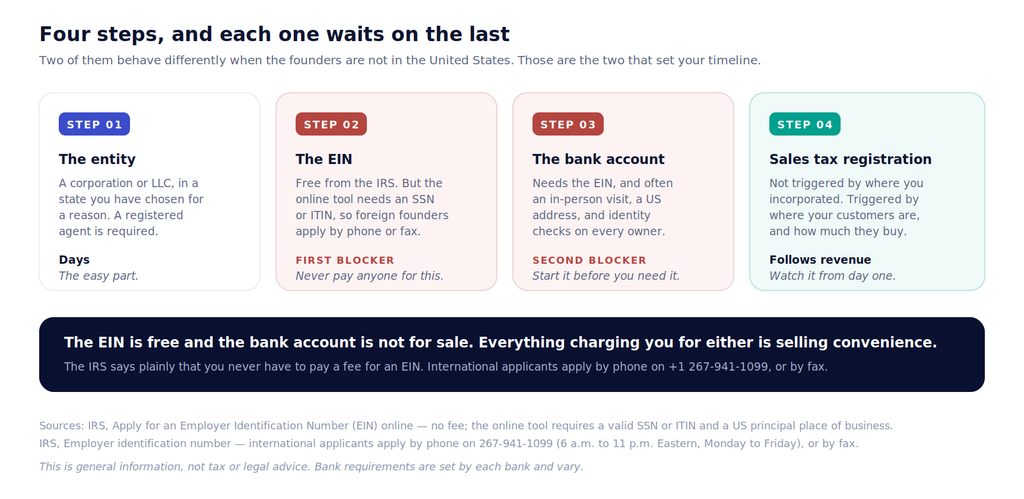
The entity is easy. The EIN is where foreign founders first meet a system that was not built for them, and the bank account is where the delay compounds.
An EIN is free. The IRS says so directly, and warns about sites that charge for it.[1] But the online application requires the responsible party to have a Social Security number or ITIN, and requires the business to have its principal place of business in the US.[1] If neither is true, you apply by phone, fax or mail instead — the international line is +1 267-941-1099, open 6 a.m. to 11 p.m. Eastern, Monday to Friday, with fax on 304-707-9471 from outside the US.[2]
That is not a difficult process. It is just a completely different process from the one every US-facing guide describes, and founders lose weeks assuming the online route failed because they did something wrong.
Nobody needs to be paid to get you an EIN. If a formation agent’s quote has a line item for it, you are buying convenience, and you should know that is what you are buying.
The bank account then waits on the EIN, and most US banks want more: identity verification on every beneficial owner, a US address, and frequently an in-person visit. It is the same substance question that stalls entries in the UK and the UAE, in an American accent. Start the conversation before you incorporate, not after.
Delaware: the right answer to one question
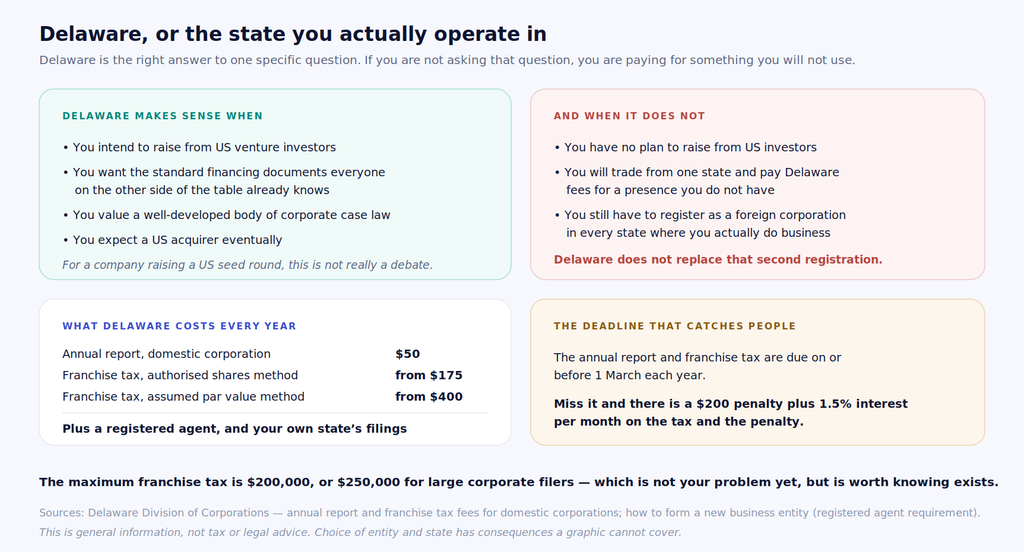
Delaware is genuinely the default for one reason: US venture investors expect it. The financing documents are standardised around it, the case law is deep and predictable, and a Delaware C-corporation removes friction from a conversation you want to be about your business rather than your structure. If you are raising a US seed round, this is not really a debate.
If you are not, look harder at it. Delaware law requires every entity to maintain a registered agent with a physical Delaware street address, which you will pay for annually.[3] The annual report costs $50 for a domestic corporation, and franchise tax starts at $175 under the authorised shares method or $400 under the assumed par value capital method — due on or before 1 March, with a $200 penalty plus 1.5% interest per month if you miss it.[4]
None of that is expensive. What makes it a bad default is that it buys you nothing you need if no US investor is involved, and it does not remove the separate obligation to register as a foreign corporation in the states where you actually have people, offices or operations. Founders who incorporate in Delaware because a blog said to, then operate from California or New York, end up maintaining two states instead of one.
The honest rule: choose Delaware because of who is going to be on your cap table, not because of where you are going to sell. Sales have nothing to do with it — as the next section explains, they create their own obligations regardless of where you filed.
The sales tax surface nobody mentions
This is the single most under-explained thing about selling into the US, and it catches software companies hardest.
Since the Supreme Court’s decision in South Dakota v. Wayfair in 2018, a state can require a seller with no physical presence in that state to register and collect sales tax based purely on economic activity. South Dakota’s own threshold is gross revenue from sales into the state exceeding $100,000 in the previous or current calendar year.[5] Other states set their own thresholds and their own rules.
Three consequences follow, and they are worth stating separately.
- You can create a tax obligation in a state you have never visited. No office, no staff, no warehouse — just customers, and enough of them.
- Whether your product is taxable at all varies by state. Software as a service is taxable in some states and not in others, and the definitions are not consistent. This is a question for a US sales tax specialist, not for an article.
- The liability is yours, not your customer’s. If you should have collected and did not, the amount does not disappear because you were unaware of it.
What to actually do about it
Track revenue by state from your first US sale, before it matters. Every serious billing and accounting stack can do this, and it costs nothing while your numbers are small. Then get a nexus review once US revenue starts to look material — the review is cheap relative to a multi-state back-assessment, and it is the kind of thing that is straightforward to fix early and painful to fix late.
Tax, briefly and honestly
Federal corporate income tax is 21% of taxable income.[6] That is the simple part. On top sit state corporate income taxes, which vary enormously and are levied on the basis of where you do business rather than where you incorporated; local taxes in some cities; and the sales tax surface described above, which is a separate system entirely.
Then there is the cross-border layer: transfer pricing between your US entity and your home entity, permanent establishment, withholding on certain payments, and whatever your double taxation treaty says. As in every other market in this series, these are cheap to set up correctly at the start and expensive to retrofit at your first year end. Raise them at incorporation.
Getting yourself there
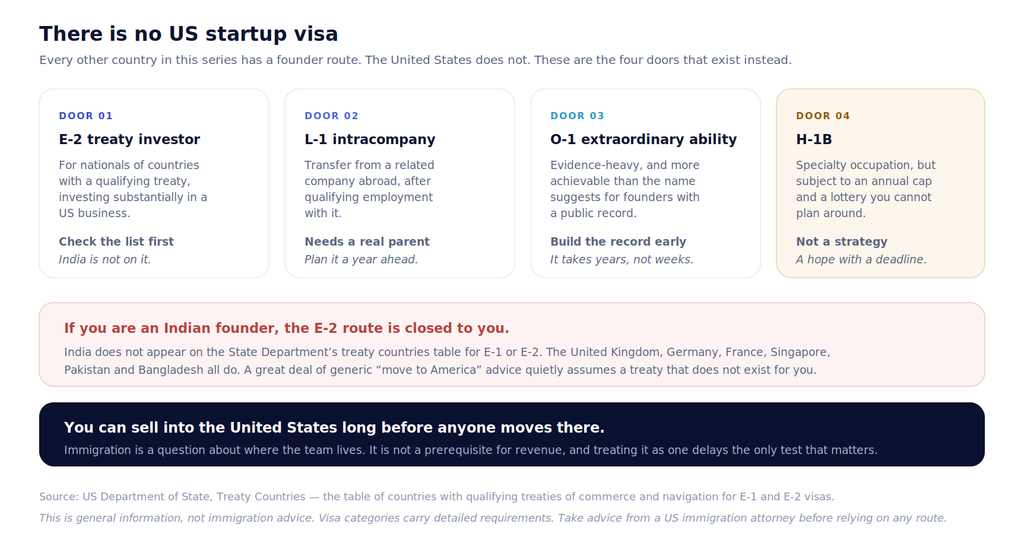
The United States has no startup visa. The UK has an Innovator Founder route, Canada has a Start-Up Visa, Singapore has EntrePass, the UAE has investor routes. The US has none, and the four doors that exist instead all have significant conditions.
The one that matters most for our own clients: India is not on the State Department’s treaty countries table for E-1 or E-2 visas, while the United Kingdom, Germany, France, Singapore, Pakistan and Bangladesh all are.[7] A large amount of “how to move your startup to America” content assumes an E-2 is available. For an Indian passport holder it is not, and discovering that after building a plan around it is an expensive way to learn it.
The practical response is not to solve immigration first. It is to notice that immigration is a question about where the team lives, and revenue is a question about whether Americans will buy. You can answer the second without the first, and you should, because the second is the one that determines whether the immigration question is worth asking.
The GTM reality
Setting up is the part with rules. Selling is the part that decides the outcome, and this is where entries most often fail quietly rather than dramatically.
Four things are genuinely different about the US market, and the first is the one people underestimate.
- It is not one market. It is a continent with regional business cultures, wildly different costs, and — as above — fifty tax regimes. “We’re launching in the US” is not a plan. “We’re selling to mid-market logistics companies in Texas and the south-east” is.
- Acquisition costs more. Every channel is more competitive and more expensive than in most other markets, because everyone is bidding for the same attention. Budget for it honestly rather than assuming your home-market numbers travel.
- Buyers move faster and churn faster. US buyers will often take a meeting quickly and make a decision quickly, in both directions. That is an advantage for testing demand and a hazard for anyone reading early enthusiasm as commitment.
- Credibility is local. A US reference customer is worth more than any amount of home-market logos. The first one is disproportionately hard and disproportionately valuable, which is an argument for pricing it as an investment rather than a deal.
The maths that persuades founders to enter is usually “the US market is ten times bigger.” The maths that decides whether it works is unit economics at US acquisition costs, with US salaries, against US competitors. Run the second before you commit to the first.
Six mistakes we see in this corridor
- Incorporating in Delaware by reflex. Correct for a US-funded company; expensive theatre for everyone else, and it never removes the home-state registration.
- Paying for an EIN. It is free. What you may reasonably pay for is someone handling the fax.
- Treating the bank account as a formality. It waits on the EIN and on identity checks, and it is the step most likely to add a month.
- Ignoring sales tax until it is a problem. Nexus follows customers, not offices, and the liability sits with you.
- Building the plan around an E-2 without checking the treaty list. For Indian founders the route does not exist.
- Launching “in the US”. Pick a segment and a region. The country is too big and too varied to enter as a whole, and a diffuse launch produces diffuse results you cannot learn from.