
Most companies pick their first international market for reasons that would not survive being written down — the language, a conference, the size of the prize. Here is a weighted model that makes the decision on evidence, and a worked example where the biggest market comes last.

Choose your first expansion market by scoring candidates against six weighted criteria: demand evidence, cost and route to acquire, regulatory and setup friction, talent and operating cost, proximity to what already works, and how easily you get paid. Set the weights before you score anything. Total addressable market is deliberately absent — a large market you cannot reach, staff or collect from is a worse first choice than a modest one you can.
This decision compounds more than almost any other in expansion. Getting the first market right means the second is cheaper, because you will have learned things that transfer. Getting it wrong consumes eighteen months and a great deal of goodwill, and teaches you mostly that expansion is hard.
How companies actually choose
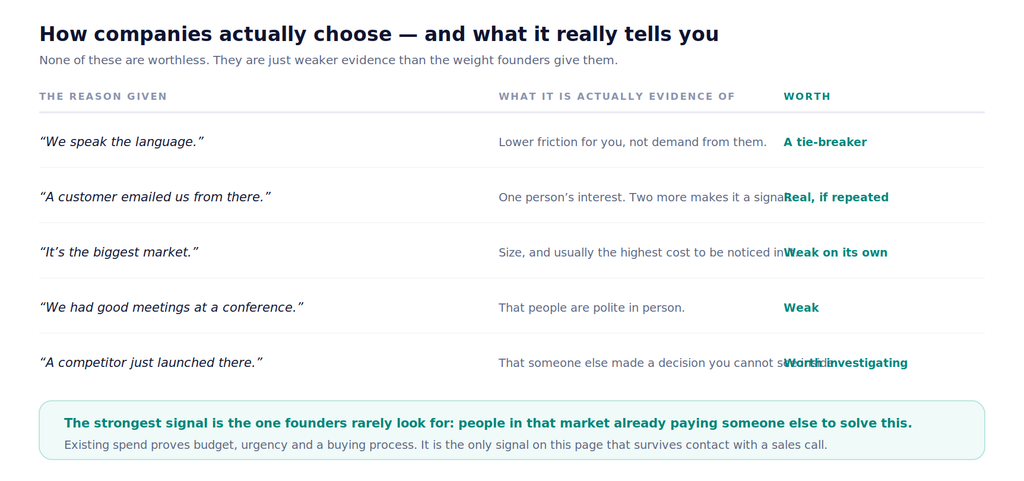
The bottom row is the one worth internalising. The strongest available signal is that people in that market are already paying someone to solve this problem — badly, partially, or expensively. Existing spend proves three things at once: there is budget, there is urgency, and there is a buying process that someone has already navigated. Nothing else on that list survives contact with a real sales call in the same way.
Market size tells you how big the prize is. Existing spend tells you whether anyone will pay you.
The six criteria
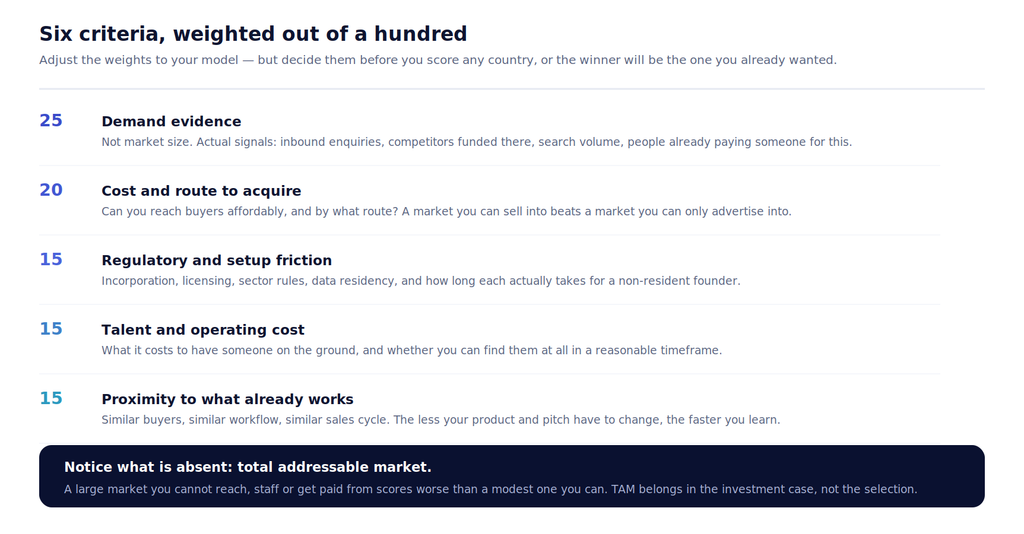
Two criteria deserve expansion because they are the ones founders systematically underweight.
Proximity to what already works (15). Every difference between your home market and the new one is a variable you will have to re-learn: the buyer’s role, the sales cycle, the compliance surface, the workflow your product sits inside. A market where your existing pitch works with minor adjustment lets you find out quickly whether you can sell at all. A market where everything changes at once means that when it fails, you cannot tell which change caused it.
Getting paid (10). Low weight, but it eliminates candidates outright. Payment rails your customers do not use, currency controls that make repatriation slow, or a market where ninety-day payment terms are standard will all quietly reshape your cash position. This is worth thirty minutes of research per candidate and it occasionally removes a market from the list entirely.
Where the evidence comes from
| Criterion | What to look at |
|---|---|
| Demand evidence | Your own inbound by country; search volume for the problem in local language; competitors who have raised or launched there; job adverts mentioning the workflow you replace |
| Cost and route to acquire | Whether an industry association, trade body or event list exists; whether cold outreach is culturally viable; local advertising costs; whether partners already sell to your buyer |
| Regulatory and setup friction | Government registry sites for incorporation steps and timelines; sector regulator guidance; data-residency rules; and cross-country benchmarks such as the World Bank’s Business Ready programme[1] |
| Talent and operating cost | Published salary surveys for the roles you need; employer-of-record providers’ country guides; whether the role exists locally at all |
| Proximity | Your own customer interviews with two or three buyers in the candidate market — there is no substitute and it is not expensive |
| Getting paid | Which payment methods dominate locally; standard B2B payment terms; any currency or capital controls |
A note on rankings. The World Bank’s Business Ready programme replaced Doing Business and, in its 2024 inaugural edition, assessed 50 economies across three pillars — regulatory framework, public services and operational efficiency — producing close to 1,200 indicators per economy.[1] It is a useful cross-country reference and it is not a substitute for checking the specific requirements that apply to your sector and your entity type. Country rankings describe an average business; you are not one.
A worked example
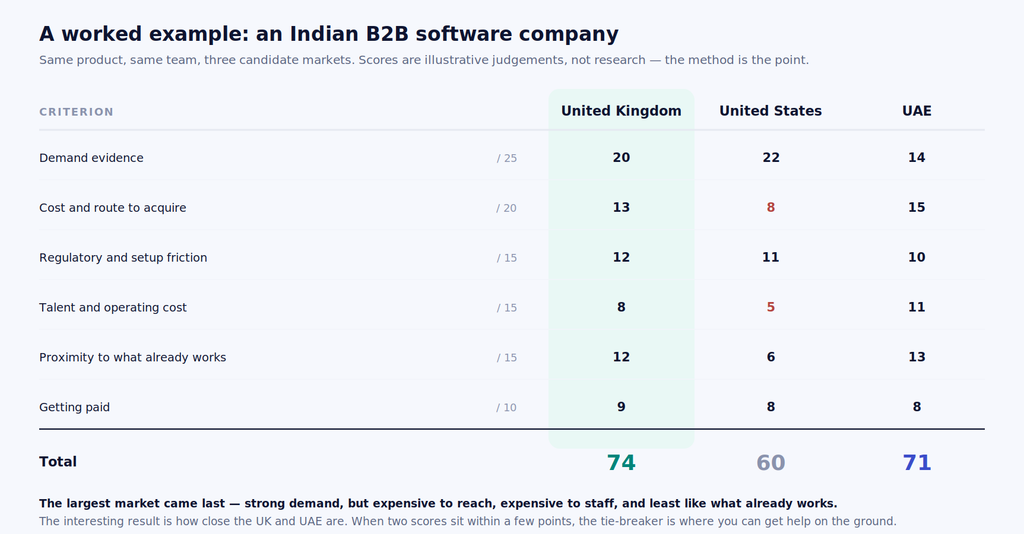
The result is instructive in two ways. The United States scored highest on demand and lowest overall, because the cost of being noticed there, the cost of staffing there, and the distance from what already worked all counted against it. That is the single most common expensive mistake in this decision.
And the top two finished three points apart, which is inside the noise of any scoring exercise. When that happens, do not treat the model as having decided. Use it to eliminate the clear loser, then choose between the survivors on a practical basis — usually where you can get credible help on the ground, or where you already have one warm relationship to start from.
Score it twice
Once by the founder, once by someone who does not want a particular answer. The gap between the two scorings is more informative than either one, and it is usually concentrated in demand evidence — which is the criterion most vulnerable to wishful reading.
Before you commit: the cheap test
Scoring narrows the field. It does not prove the market. Before incorporating anything, run a four-week test that costs almost nothing:
- Twelve conversations with buyers in the candidate market. Same discovery method as validation. You are testing whether the problem is described the same way there.
- One route to reach them, tested. An association, a partner, a community, a cold approach. If you cannot reach twelve people, your future sales team cannot either.
- One price put in front of someone. A quote, a letter of intent, a paid pilot. Willingness to pay does not transfer across borders automatically.
- One conversation with someone who has done it. A founder who entered that market from your home market, ideally in the last two years. Thirty minutes of this is worth a week of desk research.
If that month produces nothing, you have saved a year. If it produces two serious conversations, you have a first customer to build the entry around — which is a materially better starting position than an entity and a plan.
When to enter more than one market
Rarely, and later than instinct suggests. Two markets at once doubles the operational surface while halving the attention on each, and when neither works you cannot diagnose why. The exceptions are narrow: markets that genuinely function as one buying region for your product, or a second market that requires nothing beyond what the first already built.
The more useful sequencing question is when to start the second. A reasonable trigger is when the first market is producing revenue without the founder personally in every deal — the same test as any other scaling decision.
Six mistakes in market selection
- Choosing on market size. The most common and the most expensive. Size is the last filter, not the first.
- Confusing familiarity with fit. Sharing a language lowers your friction. It says nothing about whether buyers there have the problem.
- Deciding from a desk. Every criterion above except one can be researched remotely. The one that cannot — talking to buyers — is the one that decides it.
- Incorporating before validating. An entity is a commitment, and it is trivially easy to create one in a market that turns out not to want you.
- Following a competitor. You cannot see whether their expansion is working. Companies routinely follow rivals into markets that are quietly failing for them.
- Ignoring the operating cost. Founders model revenue by market carefully and salaries barely at all. The staffing line often changes the ranking.