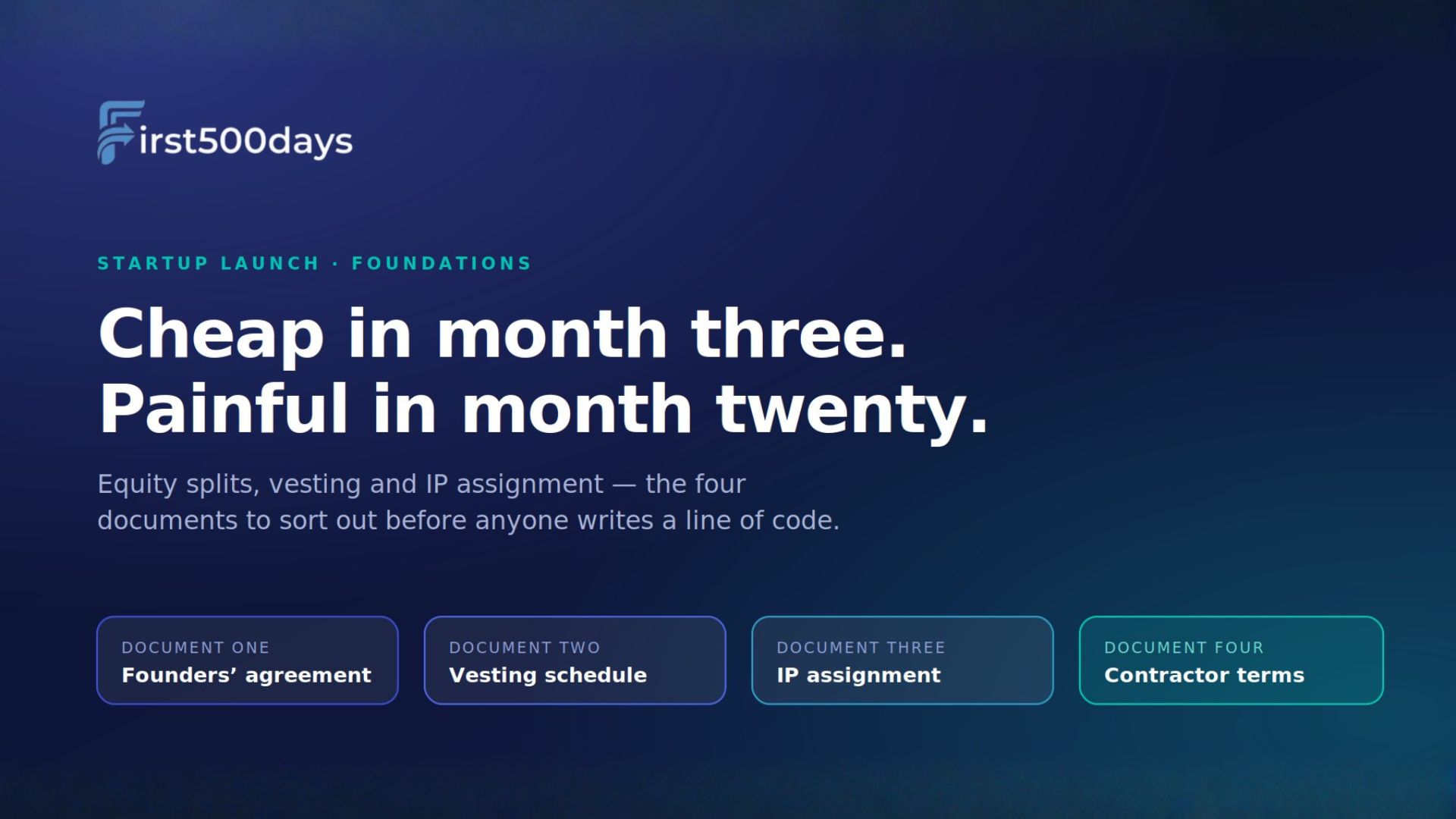
Four documents, a few thousand pounds, and one uncomfortable conversation. Skipped, they become the most expensive omission in the first 500 days — and the bill only arrives when someone leaves or an investor asks.
General information, not legal advice
This article explains concepts and market conventions so you can have a better-informed conversation with a lawyer. Company law, employment law and IP rules differ substantially by country, and none of this is a substitute for advice from a qualified professional in your jurisdiction. We are not lawyers.
Before anyone writes code, four things should exist in writing: an agreement between the founders covering roles and decision-making, a vesting schedule attached to every founder’s shares, an assignment of intellectual property from each founder to the company, and terms with anyone else who contributes — contractors, agencies, advisors. Everything else can wait. These cannot, because each one becomes progressively harder to fix as the company acquires value.
Why founders skip this, and what it costs
The reason is not ignorance. It is that the conversation is uncomfortable at exactly the moment when everyone is optimistic and nobody wants to introduce a note of distrust. So it gets deferred, and deferred, and then it is month twenty and someone wants to leave.
Noam Wasserman’s research on founding teams found that 73% of teams split the equity within a month of founding[1] — typically before roles have settled, before anyone knows who will go full-time, and before the business has pivoted at least once. The speed is the problem, not the split itself.
The costs of getting it wrong are concrete rather than theoretical:
- A co-founder leaves after eight months holding a third of the company, and nothing can be done about it.
- An investor’s due diligence finds that the developer who built version one never assigned their work, and the round stalls while it is fixed — on that developer’s terms.
- Two founders disagree, nobody has a casting vote, and the company cannot make a decision for six weeks.
- A previous employer claims rights in the product because it was started on their time.
Every one of these is cheap to prevent and expensive to remedy. That gap is the entire argument for doing it early.
Splitting the equity
There is no formula that produces the right answer, and anyone selling one is overpromising. What exists is a set of factors, a rough sense of which deserve more weight, and a strong argument for not deciding too fast.
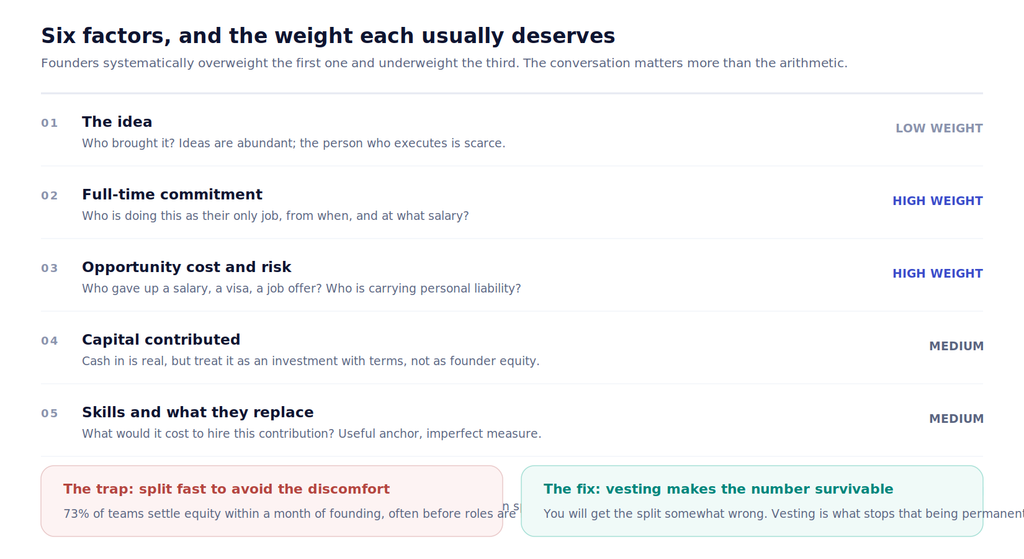
Two arguments are worth having explicitly rather than assuming.
The equal split. An even division feels fair and avoids a difficult conversation, which is precisely why it is so common. It works when commitment, risk and contribution really are symmetrical and stay that way. It becomes a problem the moment one founder goes full-time and another does not — and the equity cannot follow, because it was fixed at the start.
Capital as equity. If one founder is putting cash in, treat it as an investment with terms rather than folding it into the founder split. It keeps two different things separate: money, which is replaceable, and years of work, which is not.
The most useful reframing we offer founders is this: you will get the split somewhat wrong, because you are pricing contributions that have not happened yet. The mechanism that makes being wrong survivable is not a better negotiation. It is vesting.
Vesting: the mechanism that makes the split safe
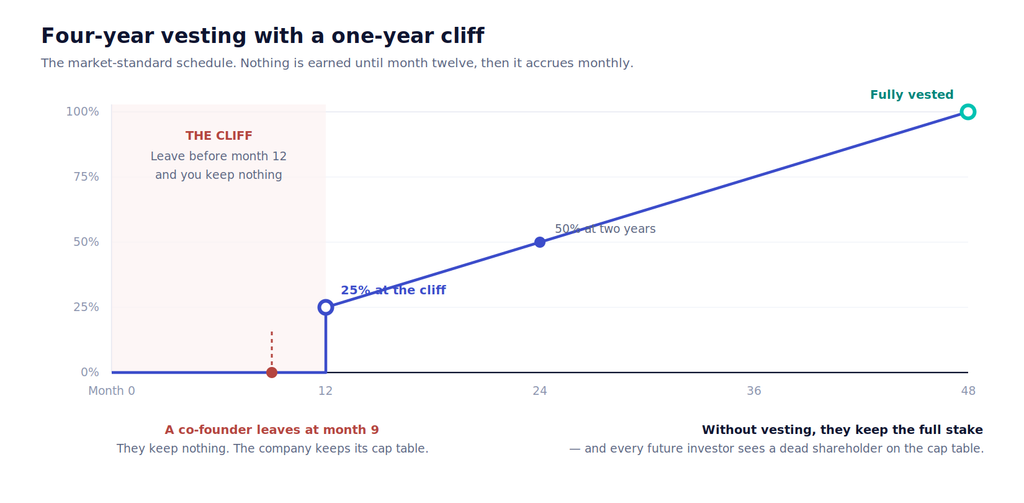
Vesting means shares are earned over time rather than owned outright from day one. The convention is four years with a one-year cliff: nothing vests in the first twelve months, 25% vests at the cliff, and the rest accrues monthly thereafter.
Founders sometimes resist applying it to themselves — it feels like being made to prove something in your own company. The better framing is that vesting protects you from your co-founders as much as it constrains you. It is the only mechanism that answers “what happens if one of us stops turning up?” before it becomes a live question.
Three details that matter:
- Credit for time already served. If you have been working on this for a year before incorporating, it is normal to backdate the vesting start so that year counts.
- Acceleration on a sale. “Single trigger” vests on acquisition; “double trigger” vests only if you are also terminated after one. Double trigger is more common and more acceptable to acquirers.
- Good leaver, bad leaver. Define what happens to unvested — and sometimes vested — shares depending on how someone leaves. This is where most founder agreements are thinnest.
A US-specific deadline worth knowing about
Founders receiving restricted stock in a US company should ask their adviser about the Section 83(b) election, which lets you be taxed on the value at grant rather than as the shares vest. The IRS is explicit on timing: an 83(b) election “must be filed no later than 30 days after the date the property was transferred.”[2] It is one of the few genuinely unforgiving deadlines in early company formation, and it is missed regularly. Equivalent considerations exist in other jurisdictions with entirely different rules — ask locally.
Intellectual property: the chain of ownership
The question an investor’s lawyer will ask is simple and awkward: can you demonstrate that the company owns everything it depends on? Not the founders. Not a former contractor. The company.
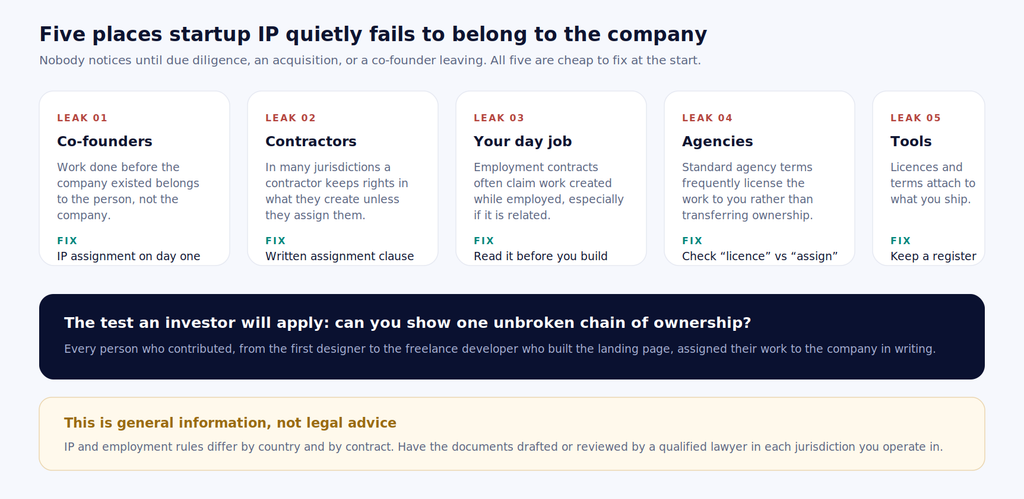
Two of these deserve expansion because they catch people who did everything else right.
Contractors are not employees. In many jurisdictions, work created by an employee in the course of employment belongs to the employer by default, while work created by a contractor belongs to the contractor unless there is a written assignment. Founders routinely assume a paid invoice transfers ownership. Frequently it does not — and the rules differ by country, which is exactly why the written assignment matters more, not less, when your developer is in a different jurisdiction from your company.
Your current employer. If you are building while employed, read your contract before you write anything. Clauses assigning inventions made during employment are common, particularly where the work is related to the employer’s business. This is worth resolving before there is anything valuable to argue about.
The cross-border version of all this
Everything above gets more complicated when the founders, the company and the developers sit in different countries — which is increasingly the norm.
| Situation | What changes | Practical step |
|---|---|---|
| Co-founders in different countries | Employment, tax and IP rules differ for each person | Local advice per founder; one governing law in the agreement |
| Company here, developers there | Assignment validity depends on the contractor’s jurisdiction | Written assignment governed by law that will actually be enforceable |
| Founder on a visa | Shareholding and directorship may affect immigration status | Check before allotting shares, not after |
| Holding company abroad | Where IP sits affects tax and future transactions | Decide the structure before IP accumulates value |
The single most useful principle: decide which country’s law governs the founder documents, and make sure every contributor’s assignment works under a system that a court would enforce. A perfectly drafted agreement governed by the wrong law is decoration.
What each document actually needs to say
| Document | Must cover | Usually missing |
|---|---|---|
| Founders’ agreement | Roles, decision-making, casting vote, time commitment, what happens on departure | Deadlock resolution; what “full-time” actually means |
| Share terms / vesting | Schedule, cliff, acceleration, good and bad leaver definitions | Leaver definitions; credit for pre-incorporation work |
| IP assignment | Present assignment of existing and future work; moral rights where relevant | Work done before the company existed |
| Contractor / agency terms | Assignment rather than licence; delivery; confidentiality | The word “assign” — many templates only license |
Trademarks: not urgent, but not never
Trademarks are the one item on this list that can reasonably wait — but not indefinitely, and the sequencing is worth understanding.
Before naming the company, do a basic clearance check in your main markets so you do not build a brand you cannot keep. Registration itself can usually wait until the name has survived a pivot or two, and until you know which countries matter, since protection is territorial and filing everywhere is expensive. The trigger to file is commercial: meaningful revenue, a market you intend to stay in, or a competitor operating nearby.
Domain and social handles are worth securing early — they are cheap, and unlike trademarks they cannot be recovered by argument.
What this should cost
A straightforward founder package — incorporation, founders’ agreement, vesting terms and IP assignments — is typically a low four-figure sum in most markets, and less where template-based services are appropriate. Cross-border structures, multiple share classes or investor-facing documents cost more.
Compare that against the alternative. Renegotiating an equity split after a founder departure, or fixing a broken IP chain during a live funding round, routinely costs several times more — and is paid at the worst possible moment, from a position of weakness. This is the cheapest insurance available in the first 500 days.