With no sales history there is nothing to extrapolate from — so founders default to cost-plus, or to whatever the nearest competitor charges. Both leave money on the table, and one of them is close to irreversible.
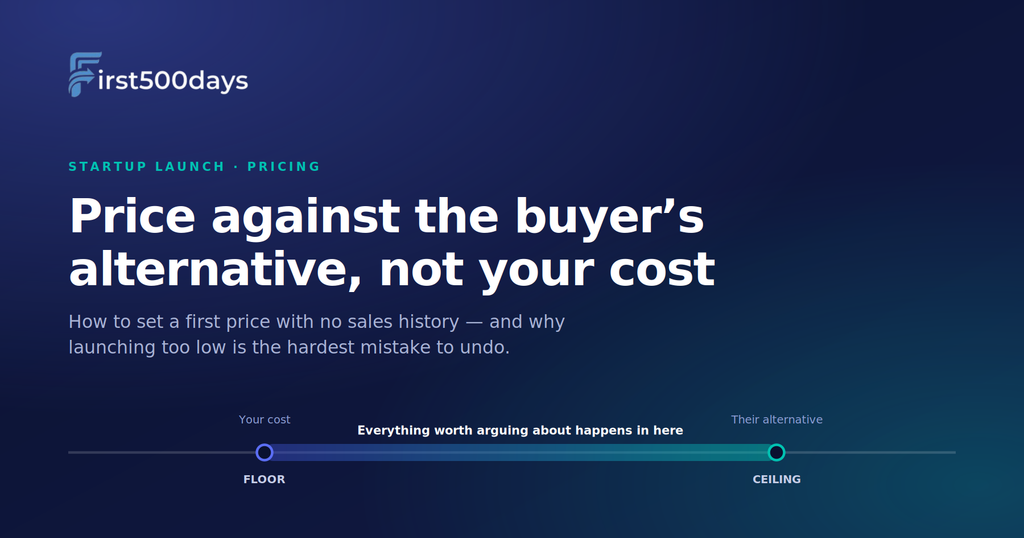
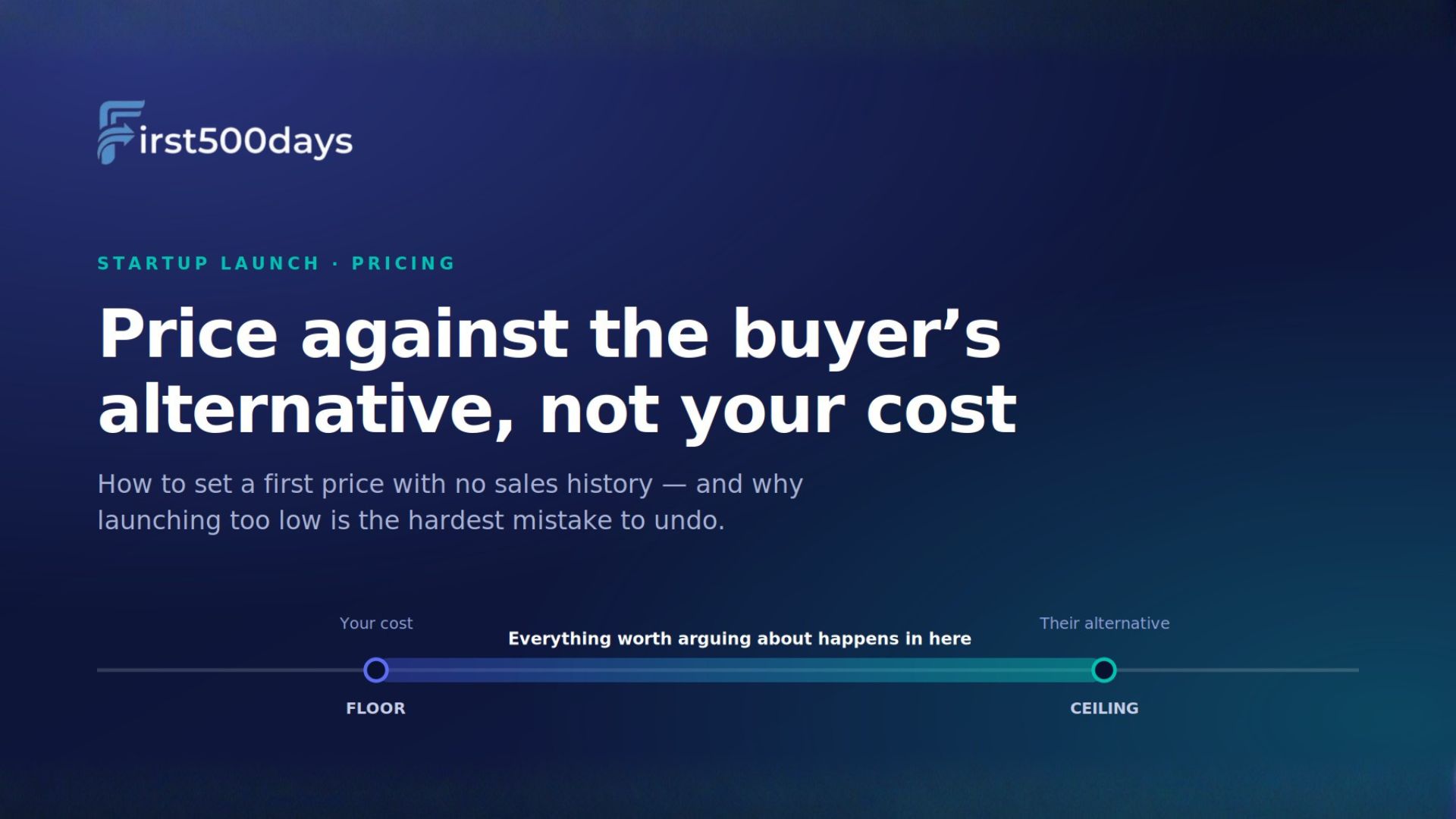
To price a product with no sales history: work out what the problem currently costs the buyer — in staff hours, delay, errors or lost revenue — and set that as your ceiling. Your cost to deliver is the floor. Price inside that corridor, closer to the ceiling than instinct suggests, and confirm it by putting a real number in front of a real buyer before you launch. Then launch at the top of the range you can defend, because raising a price later is far harder than discounting one.
Most first prices are set in an afternoon, by a founder, using arithmetic based on their own costs. It is the single most under-examined number in an early-stage company, and it determines more than almost any other decision you will make in the first year.
Why the first price matters more than it looks
Price flows straight to the bottom line in a way volume never does. McKinsey’s analysis of an average S&P 1500 income statement found that a 1% price rise, with volumes held stable, produced an 8% increase in operating profits — nearly 50% more than a 1% cut in variable costs, and more than three times the effect of a 1% increase in sales volume.[1] The study is from 2003 and the arithmetic has not changed: a small pricing move outweighs a large operational one.
For an early-stage company the stakes are higher still, because the first price does not just affect margin. It selects your customer, sets your acquisition budget, and quietly decides what kind of company you are able to build. We will come back to that.
A price nobody ever questions is not evidence that you priced well. It is evidence that you priced low.
The pricing corridor
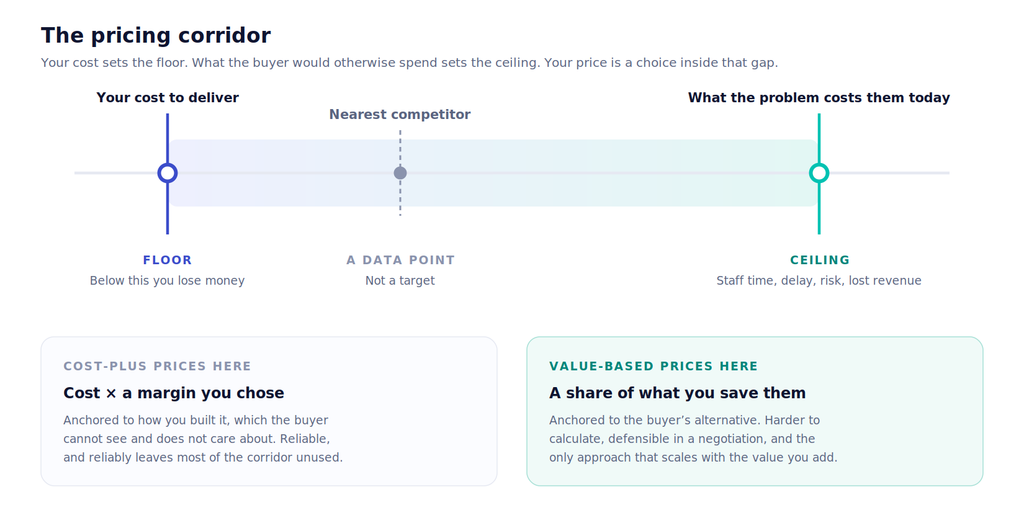
Every price sits between two boundaries. Getting clear on both is most of the work.
Anchor 1: your cost — the floor, and a trap
Cost-plus pricing is popular because it is calculable. You know what it costs to build and deliver; you add a margin; you have a number by lunchtime.
The problem is that your cost is invisible to the buyer and irrelevant to them. Nobody has ever chosen a supplier because that supplier had a reasonable markup. Worse, cost-plus punishes you for being efficient: the better you get at delivering, the less you are allowed to charge.
Use cost for exactly one thing — knowing where the floor is, and therefore which deals to walk away from.
Anchor 2: the competitor — useful, and misleading
Competitor pricing tells you what the market has been trained to expect. That is genuinely worth knowing. It is not worth copying, for three reasons: their cost structure is not yours, their product is not solving exactly your problem, and their price may itself have been set badly.
There is also a strategic trap. If you match a competitor’s price, the buyer has no reason to choose you except preference. If you undercut, you have started a conversation about cost rather than value, and you rarely get to change the subject later.
Anchor 3: the buyer’s alternative — the one that matters
The ceiling is what the problem costs the buyer right now, including the option of continuing to do nothing. That number is almost always larger than founders assume, and it is the only anchor that scales with the value you create rather than the effort you expend.
It is also the argument you sell with. “This costs £1,200 a month” invites comparison. “You are currently spending eleven hours a week on this; here is what that costs you, and here is what we charge” is a different conversation entirely.
How to calculate the ceiling
The method is arithmetic, and the numbers come from your customer interviews rather than from you. An illustrative example, using round numbers:
Suppose you are selling scheduling software to independent clinics. In discovery you learn that a typical clinic loses roughly six appointment slots a week to no-shows, that each slot is worth about ₹900, and that a receptionist spends around four hours a week chasing confirmations at a loaded cost of roughly ₹300 an hour.
| Component | Weekly | Monthly |
|---|---|---|
| Lost appointment revenue (6 × ₹900) | ₹5,400 | ₹23,400 |
| Staff time chasing confirmations (4 × ₹300) | ₹1,200 | ₹5,200 |
| Total cost of the status quo | ₹6,600 | ₹28,600 |
That ₹28,600 is the ceiling. If your product removes even half of that, you are creating roughly ₹14,000 a month of value, and a price of ₹4,000–6,000 a month is defensible arithmetic rather than a hopeful guess. A cost-plus approach on the same product might have produced ₹1,500, and the founder would never have known what they left behind.
The share you can capture
You will not capture the whole value you create, and should not try. As a working rule, a price in the range of 20–35% of the value delivered is defensible in most B2B contexts — enough for the buyer to see an obvious return, enough for you to fund a real business. Below 10% you are giving the product away; above 50% the buyer starts asking why they should not build it themselves. These are planning heuristics from our engagements, not published research.
Four ways to find out what someone will pay
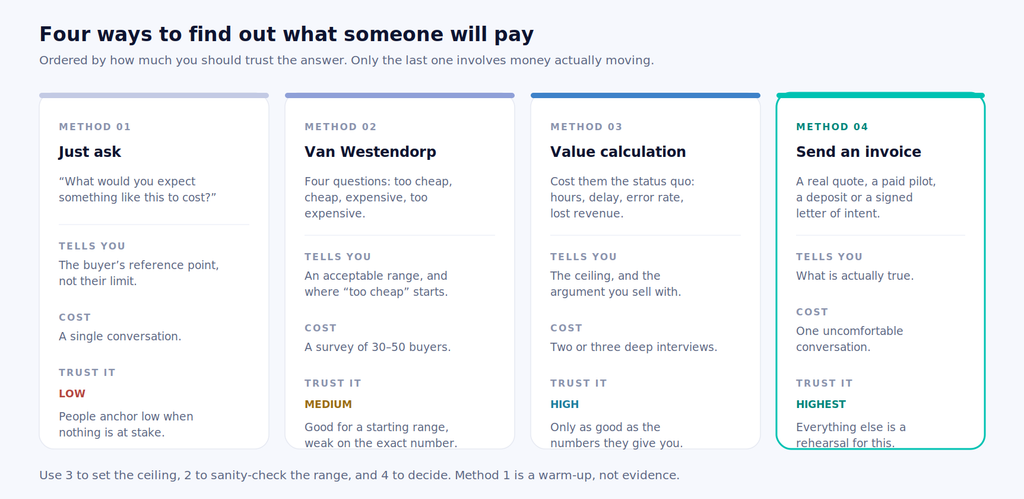
Just asking gives you the buyer’s reference point, which is useful context and terrible evidence. With nothing at stake, people anchor low and mean it sincerely.
The Van Westendorp price sensitivity meter, developed by Peter van Westendorp in 1976, asks four questions: at what price would this be too expensive, expensive but worth considering, a bargain, and so cheap you would doubt its quality? The fourth question is the interesting one for founders, because it reveals a floor below which low price actively destroys credibility. It needs thirty to fifty responses to be meaningful and gives you a range rather than a number.
The value calculation above is where your ceiling comes from and where your sales argument comes from. Two or three deep interviews will produce it.
Sending an invoice is the only one that is evidence. A written quote, a paid pilot, a deposit, or a signed letter of intent. Everything else is rehearsal.
A practical sequence: use the value calculation to find the ceiling, Van Westendorp to sanity-check the range, and a real quote to decide. If the quote is accepted without hesitation by the first three buyers, your price is too low — and you have just learned that cheaply.
Choosing the model, not just the number
How you charge often matters more than how much. The model should track whatever grows as the customer gets more value.
| Model | Works when | Fails when |
|---|---|---|
| Per seat | Value scales with number of users; buying unit is a team | Automation reduces the seats needed — you are penalised for working |
| Usage-based | Consumption tracks value closely; costs are variable | Buyers need budget certainty; procurement blocks variable spend |
| Flat tiers | Buyers want predictability; the segments are clearly different | One tier absorbs everyone and the others never get chosen |
| Outcome-based | The outcome is measurable and attributable to you | Attribution is contested, or the customer controls the outcome |
| Platform fee + usage | You have both fixed and variable costs to cover | It becomes too complex to explain in one sentence |
One rule regardless of model: a buyer must be able to predict their bill before they receive it. Pricing that surprises people is churn with a delay built in.
Why underpricing is so hard to undo
Discounting a price is easy. Raising one is not — because by the time you want to, the low price has already made a series of decisions on your behalf.
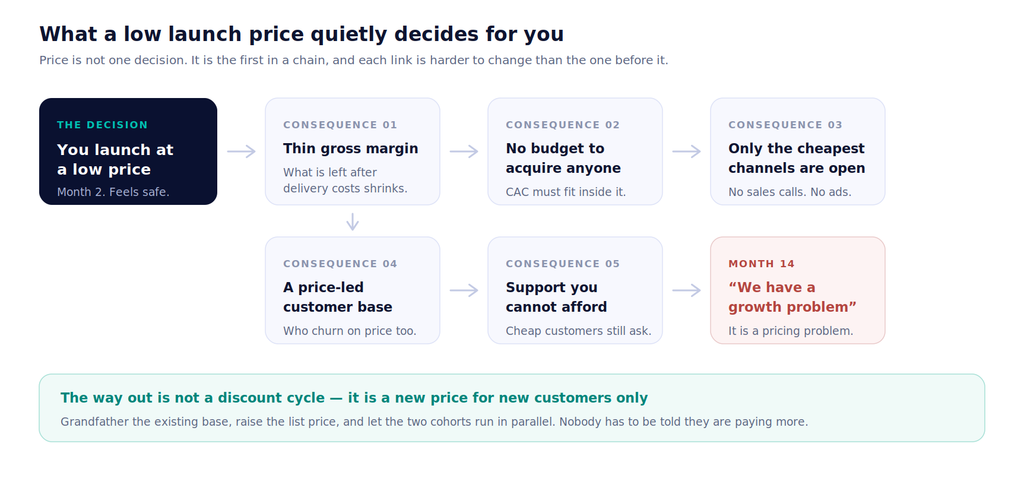
he chain is worth reading slowly. A low price produces thin gross margin, which caps what you can spend acquiring a customer, which closes off every channel except the cheapest, which selects for price-sensitive buyers, who churn on price and still need support you cannot fund. None of these are visible in month two. All of them are structural by month fourteen.
This is also why “we’ll start low and raise it once we have traction” rarely survives contact with reality. The customers you acquired at the low price are the ones least able to absorb an increase, and they are now your reference customers, your case studies and your word of mouth.
How to raise a price you have already set
If you are reading this having already launched too low, the situation is recoverable. The mechanism is cohorts, not confrontation.
- Change the list price for new customers only. Existing customers keep their price. Nobody has to be told anything.
- Change something visible at the same time. A new tier, a packaged capability, a clearer plan structure. The price is attached to a new thing rather than to the same thing costing more.
- Watch the close rate, not the complaints. If conversion holds at the higher price, the old one was wrong. If it drops sharply, you have learned where the boundary is — also useful.
- Give the existing base a long runway. When you do eventually move them, six to twelve months’ notice with a clear reason, and honour the old price for anyone who commits to a longer term.
- Do not run a discount cycle in the meantime. Repeated discounting teaches buyers to wait, and that lesson is permanent.
Pricing the same product in a different market
The corridor moves when you cross a border, and not by the exchange rate. Both boundaries shift: your cost to deliver changes with local staffing and compliance, and the ceiling changes because the same problem costs a different amount in a different economy.
Two failure modes are common. Converting your home price at spot rate produces something either unaffordable or absurdly cheap, depending on direction. And publishing wildly different prices across regions without any structure invites arbitrage — buyers in the expensive market simply purchase through the cheap one.
The workable approach is to recalculate the ceiling locally, keep the pricing structure identical across markets, and vary only the number — with terms that tie the price to the region of use rather than the region of purchase.
Seven pricing mistakes
- Pricing in an afternoon. The number that determines your margin, channel and customer deserves more than one sitting.
- Asking customers what they would pay. They will answer honestly and be wrong. Put a real number in front of them instead.
- Anchoring on the cheapest competitor. You have chosen to compete on the only dimension where a bigger company always wins.
- Free pilots. A free pilot proves someone will accept something free. Charge a small amount — the information is worth more than the revenue.
- Discounting to close the first deals. Those customers become your reference price, and the discount becomes the price.
- Too many tiers. Three is usually right. Five means you have not decided who the customer is.
- Never revisiting it. Pricing is not a launch task. Review it every two quarters against what customers actually value.