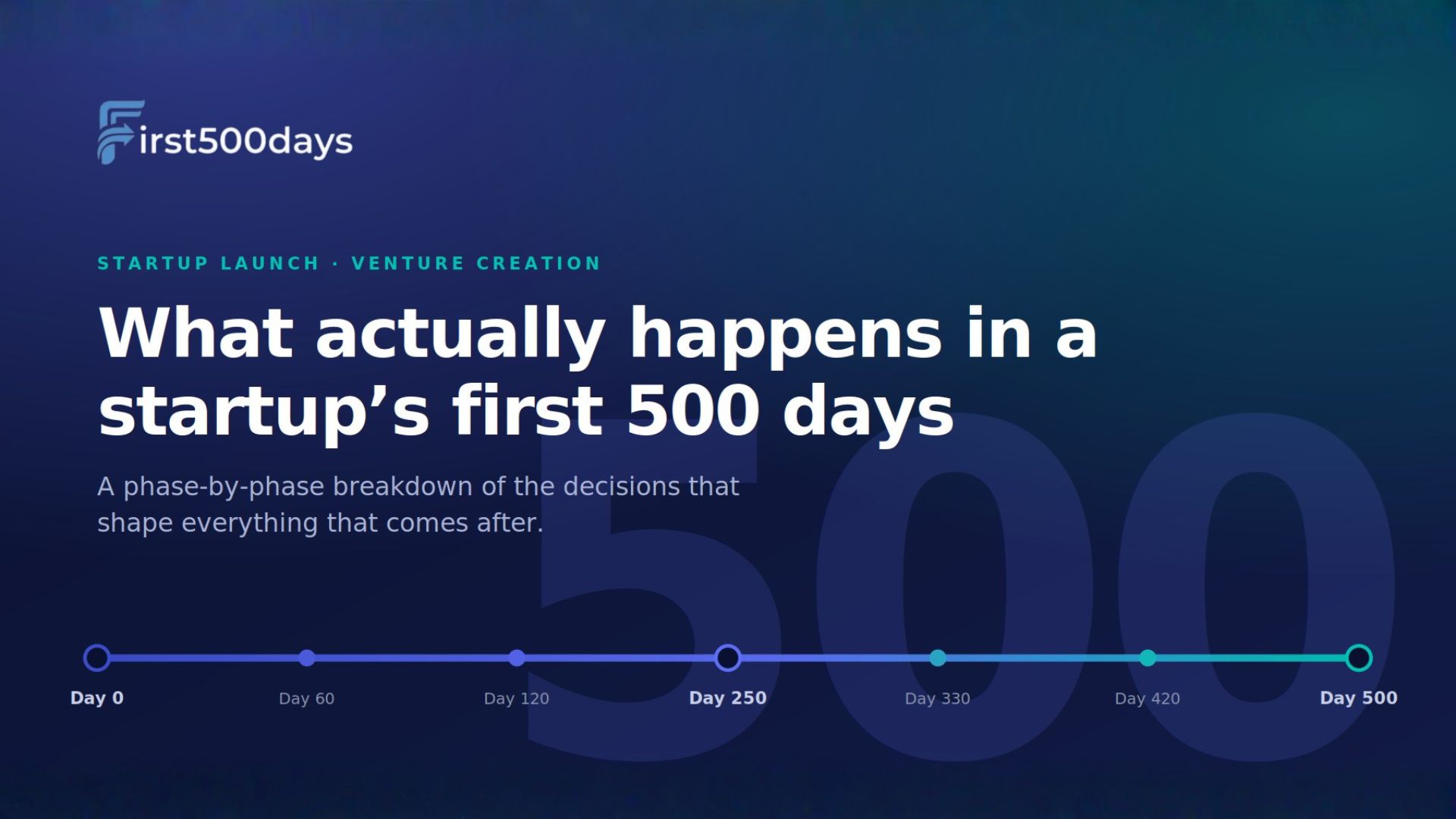
Roughly sixteen months separate “I have an idea” from “I have a business that can be funded or scaled.” Here is what occupies that window, phase by phase, with the checkpoints that tell you whether you are on track.
Most founders can describe day one and imagine year three. The middle is where it gets vague — and the middle is where companies are actually decided.
The first 500 days cover the period from the moment you commit to an idea through to the point where the business either has a repeatable way of making money or does not. Almost every structural decision that matters is made in this window: who the customer is, what you charge, what you build, who owns what, and whether growth depends on the founder being in the room.
This article maps that window into seven phases, gives you the four checkpoints that tell you whether you are progressing or drifting, and sets out what usually goes wrong at each stage.
What are the first 500 days of a startup?
The first 500 days of a startup are the roughly sixteen-month window between committing to a business idea and having a venture that can be scaled or funded. In practice the window contains seven overlapping phases: discovering the opportunity, designing the business model, establishing the legal and brand foundation, building the first product, launching and acquiring customers, building operations that scale, and preparing for growth or investment.
It is not a fixed calendar. A regulated HealthTech venture and a self-serve SaaS product move at very different speeds. What holds across both is the sequence: the order in which decisions get made determines how expensive it is to get them wrong.
Why 500 days, and not one year?
Twelve months is a tidy number and the wrong one. It is long enough to build something and too short to find out whether anyone wants it.
Five hundred days — about sixteen and a half months — is closer to how long the full arc actually takes. Consider one benchmark: according to Carta, the median gap between a seed round and a Series A reached 616 days in the second quarter of 2025, more than two months longer than two years earlier.[3] Your first 500 days end before the average company even begins the wait for its next round. This is the setup period, not the growth period, and treating it as though it were the growth period is one of the most common and most expensive mistakes founders make.
The question at day 500 is not “how big are we?” It is “does this business work without heroics?”
The seven phases, mapped
The phases overlap. Real ventures run discovery while drafting a business model, and start selling before the product is finished. The chart below shows the typical shape for a venture starting from a reasonably validated idea.
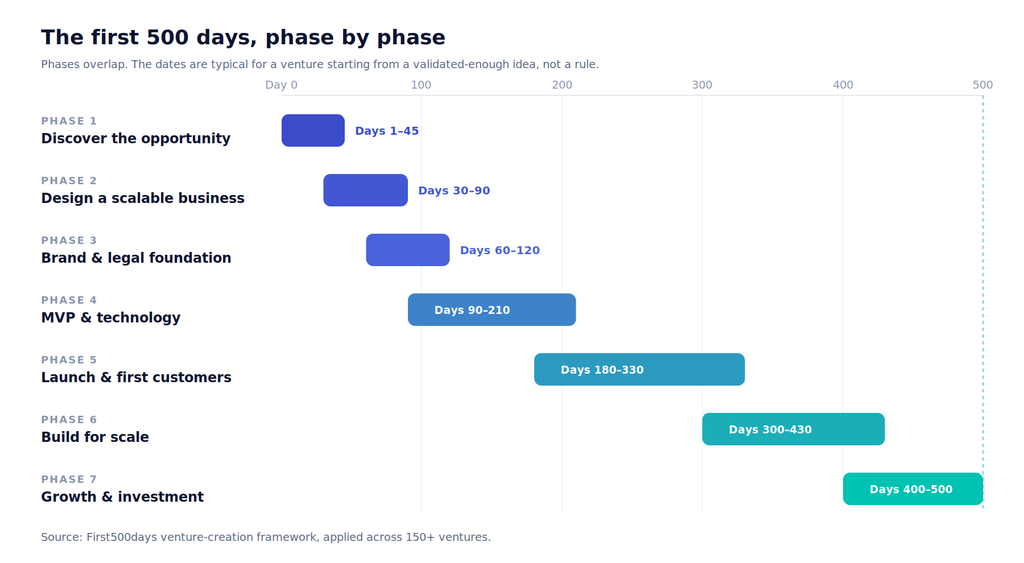
Phase 1 — Discover the right opportunity (days 1–45)
The work here is subtraction. You start with a broad idea and end with a narrow, specific statement of whose problem you are solving and why it is worth money to them.
What actually happens: founder discovery sessions, problem identification, industry and competitor research, and — the part most founders skip — twelve to twenty conversations with people who have the problem. Not a survey. Conversations, where you mostly listen.
The decision that matters: which single customer segment you are building for. Choosing one means deliberately parking others, and founders resist this because narrowing feels like shrinking the opportunity. It is the opposite: a narrow segment is the only way to build something specific enough to be worth switching to.
What you should have at the end: a written problem statement in the customer’s own language, a competitor map, a short list of what would have to be true for this to be a real business, and an honest go / no-go.
What goes wrong: validating the idea you already love. If every conversation confirms your hypothesis, you are asking leading questions.
Phase 2 — Design a scalable business (days 30–90)
An idea is not a business. This phase answers how value gets created, delivered and captured — and whether the arithmetic works at any meaningful scale.
What actually happens: business model design, revenue model, pricing, value proposition, customer personas, financial planning and a first pass at unit economics.
The decision that matters: price. Price sets your customer, your sales motion, your margin and your hiring plan. Launch too low and you will spend two years trying to climb out, because early customers anchor expectations and your cost base gets built around the wrong number.
What you should have at the end: a business model canvas, a revenue and pricing strategy, a financial model with stated assumptions, and unit economics that fit on one page.
What goes wrong: a financial model built backwards from a desired outcome. If the plan requires 4% conversion because 3% does not work, the plan is decoration.
Phase 3 — Build the brand and legal foundation (days 60–120)
Unglamorous and cheap to do now, expensive to fix later.
What actually happens: company formation, founder agreements with vesting, IP assignment, trademark coordination, banking, accounting setup, brand identity and a website that does more than exist.
The decision that matters: where to incorporate, and on what terms the founders hold equity. Both are hard to unwind. If you plan to sell into the UK, the US or the Gulf, or to raise from investors based there, the entity decision interacts with your go-to-market plan and should not be made purely on tax.
What you should have at the end: a registered company, signed founder terms including vesting and IP assignment, a bank account, a brand identity kit and a live website.
What goes wrong: a handshake between co-founders. The cost of an unwritten equity agreement only becomes visible when someone leaves — which is exactly when it is hardest to fix.
Phase 4 — Build the MVP (days 90–210)
The longest single phase for most ventures, and the one most likely to consume the whole budget if the scope is not held.
What actually happens: product strategy, UX, MVP or AI product development, analytics instrumentation, and a launch plan built in parallel rather than afterwards.
The decision that matters: what to leave out. An MVP exists to test the one assumption that would kill the business if it were wrong. Everything not serving that test is deferred, however reasonable it sounds.
What you should have at the end: a working product in real users’ hands, instrumented well enough to tell you what people actually do rather than what they say.
What goes wrong: building for eighteen months before showing anyone. If your first external user sees the product after day 210, the feedback arrives too late to be cheap.
Where founders lose the most time
In our experience across venture-creation engagements, the two phases that overrun most are discovery and MVP — and they overrun for opposite reasons. Discovery overruns because founders keep researching instead of deciding. MVP overruns because scope was never frozen. Both are fixed by writing down, in advance, what “done” means.
Phase 5 — Launch and acquire customers (days 180–330)
A company with a product and no customers is a project. This is the phase where that changes, or does not.
What actually happens: positioning and messaging, launch strategy, funnel design, founder-led sales, early digital marketing, SEO foundations, partnerships and the first customer-success motion.
The decision that matters: which single acquisition channel to make work first. Founders spread thin across five channels and learn nothing from any of them. One channel, run properly for ninety days, produces a cost per customer you can actually plan with.
What you should have at the end: paying customers, a known cost to acquire one, and a clear account of why the customers who left, left.
What goes wrong: spending on paid acquisition before product–market fit. Paid media makes a working funnel bigger; it does not make a broken one work.
Phase 6 — Build for scale (days 300–430)
The shift from survival to system. Everything that has been held together by the founders’ attention needs to start running on process.
What actually happens: hiring strategy and the first real hires, team structure, SOPs, KPI frameworks, dashboards, automation and workflow integration.
The decision that matters: when to hire, and in what order. Hiring ahead of a validated motion converts a cash problem into a cash crisis; hiring behind it means the founders become the bottleneck.
What you should have at the end: documented processes for the things you do repeatedly, a small team that knows what it owns, and a weekly number everyone can see.
What goes wrong: premature scaling — building the org chart of the company you hope to be rather than the one you have.
Phase 7 — Prepare for growth and investment (days 400–500)
Whether or not you intend to raise, this phase is about being legible to an outsider.
What actually happens: financial forecasting, investor deck and narrative, data room assembly, due-diligence preparation, growth planning, and — where relevant — an international expansion thesis.
The decision that matters: whether to raise at all. Capital is one option among several, and the right answer depends on gross margin, sales cycle and how capital-intensive growth actually is for you.
What you should have at the end: a twelve-month plan you can defend line by line, a data room that does not embarrass you, and a narrative that connects what you have proved to what you intend to prove next.
What goes wrong: starting the raise before the evidence exists. A deck cannot compensate for six months of missing traction, and a failed process makes the next one harder.
The four checkpoints
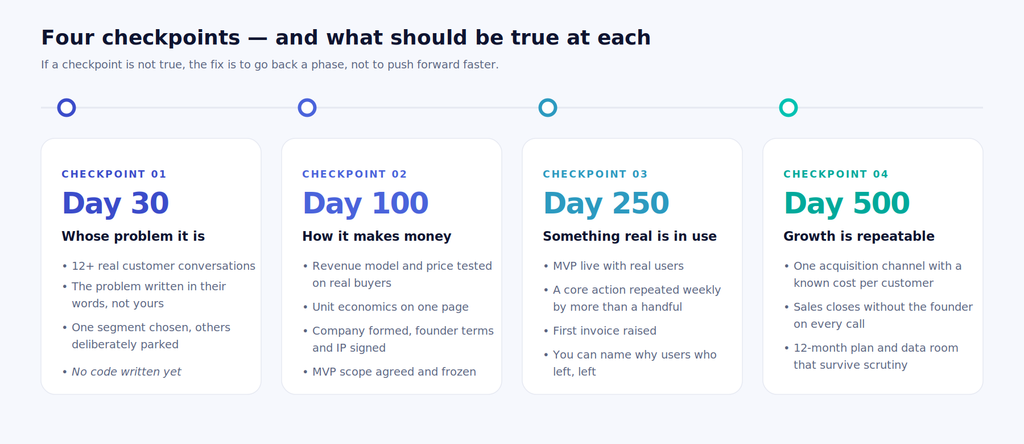
Phases are useful for planning. Checkpoints are useful for honesty. At four points in the 500 days there are things that should simply be true; if they are not, the answer is to go back a phase rather than push forward faster.
What goes wrong, and when
Failure rarely announces itself. It compounds quietly from a decision made months earlier.
The broad numbers are worth holding lightly but knowing. US Bureau of Labor Statistics data on new business establishments shows one-year survival rates varying by region and cohort — from around 71% for establishments born in 2008 in the South Atlantic division to a peak of about 85% for Pacific-division establishments born in 2021.[1] Most new businesses survive their first year. Surviving is not the hard part.
For venture-backed companies specifically, CB Insights analysed 431 startups that shut down since 2023 and identified causes for 385 of them.[2] Companies typically cited more than one cause, so the shares below exceed 100%.
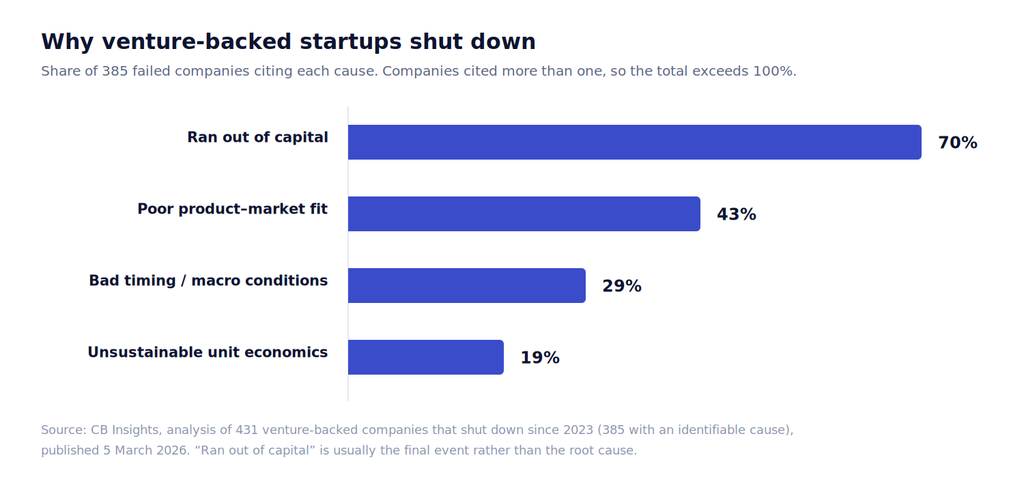
The useful reading of that data is not “raise more money.” Running out of capital is what failure looks like from the outside. Poor product–market fit and unsustainable unit economics are what caused it — and both are set during phases 1, 2 and 5 of the first 500 days, long before the bank balance becomes the visible problem.
Mapped onto the phases, the pattern looks like this:
| Phase | The failure that starts here | When it usually surfaces |
|---|---|---|
| 1. Discover | Solving a problem nobody prioritises | Day 250–400, when nothing converts |
| 2. Design | Price and margin that cannot support a sales motion | Day 400+, when CAC exceeds gross profit |
| 3. Foundation | Undocumented equity, IP held personally | At the first co-founder exit or diligence |
| 4. MVP | Scope creep consuming the runway | Day 200–300, when cash runs short pre-launch |
| 5. Launch | No channel with a known cost per customer | Immediately, but often ignored for months |
| 6. Scale | Hiring ahead of a validated motion | Within one or two quarters of hiring |
| 7. Investment | Raising without evidence | During the process, in the second meeting |
How long each phase really takes
The single biggest driver of timeline is not effort. It is whether the venture is regulated, and whether the founder is working on it full time.
| Phase | Typical | What makes it longer |
|---|---|---|
| Discover the opportunity | 4–7 weeks | Hard-to-reach buyers; enterprise or clinical users; part-time founders |
| Design the business | 4–8 weeks | Multi-sided models; usage-based pricing; unclear buyer vs user |
| Brand & legal foundation | 3–8 weeks | Cross-border incorporation; non-resident banking; IP assignment across countries |
| MVP & technology | 8–18 weeks | Regulatory requirements; integrations; AI systems needing evaluation sets |
| Launch & first customers | 12–22 weeks | Long enterprise sales cycles; procurement; security review |
| Build for scale | 10–18 weeks | Hiring in a new market; distributed teams across time zones |
| Growth & investment | 8–14 weeks | Incomplete financial records; diligence gaps; cold investor network |
These ranges are First500days estimates based on our venture-creation engagements, not published research. Treat them as planning anchors, not benchmarks.
What the first 500 days cost
There is no single number, and anyone giving you one is selling something. What can be said honestly is where the money goes and in what proportion.
For a typical software venture, product build is the largest line by a wide margin — usually 45–65% of total spend across the window. Company formation, legal and compliance are small in absolute terms but front-loaded. Go-to-market spend should stay deliberately low until phase 5 produces a cost per customer worth scaling. Founder salary, if taken at all, is usually the swing factor between a lean 500 days and an expensive one.
Two structural choices move the total more than anything else: where you build (engineering cost varies by several multiples across markets) and how tightly you hold MVP scope. Everything else is rounding error by comparison.
A note on honesty
We publish indicative ranges for our own engagements rather than “contact us for pricing.” If a partner will not give you a range before a proposal, the range is probably not the number you would like.
A 500-day plan you can copy
Condensed, and deliberately unambitious. Most plans fail because they assume everything goes right.
- Weeks 1–6: Twelve customer conversations. Write the problem in their words. Decide go / no-go in writing.
- Weeks 5–12: Business model, pricing tested against real buyers, unit economics on one page.
- Weeks 9–17: Incorporate. Sign founder terms with vesting. Assign IP. Open banking. Ship a real website.
- Weeks 13–30: Freeze MVP scope in writing. Build. Instrument. Show it to ten real users before it is finished.
- Weeks 26–47: Launch. Founder-led sales. One acquisition channel, run for ninety days. Raise the first invoice.
- Weeks 43–61: Document what you repeat. First hires against the bottleneck, not the org chart. One weekly number.
- Weeks 57–71: Twelve-month plan. Data room. Decide whether to raise — and be willing to decide not to.
The mistakes we see most often
- Building before deciding. Code is the most expensive way to have an opinion about a market.
- Confusing activity with progress. A busy week with no decision closed is a lost week.
- Treating validation as a formality. If the research cannot change your mind, it is not research.
- Hiring to feel like a company. Headcount is a consequence of a working motion, not a cause of one.
- Under-pricing to win the first ten customers. Those ten customers set the ceiling for the next hundred.
- Postponing the boring paperwork. Equity, IP and compliance are cheap in month three and painful in month twenty.
- Raising as a milestone. Funding is a tool for a specific job. If you cannot name the job, you are not ready.