Twenty years in a field buys you better questions and faster access. It does not buy you distribution, pricing power, or the ability to decide before the evidence is in — and that gap is where most expert-led ventures stall.
Deep expertise transfers to exactly four things when you start a company: knowing which problems are real, judging what is technically hard, being credible with peers, and reaching early users quickly. It does not transfer to distribution, pricing, selling to non-experts, or making decisions with incomplete information. Expert-founders stall because they assume the second list comes free with the first.
This is not a criticism of experts. It is a description of a role change that nobody announces. You spent years being rewarded for being right; you are now in a job that rewards being chosen. Those are different tests, and the second one is judged by people who cannot evaluate how good your underlying work is.
What your expertise actually gives you — and what it withholds
Be precise about the head start, because it is real and worth using deliberately.
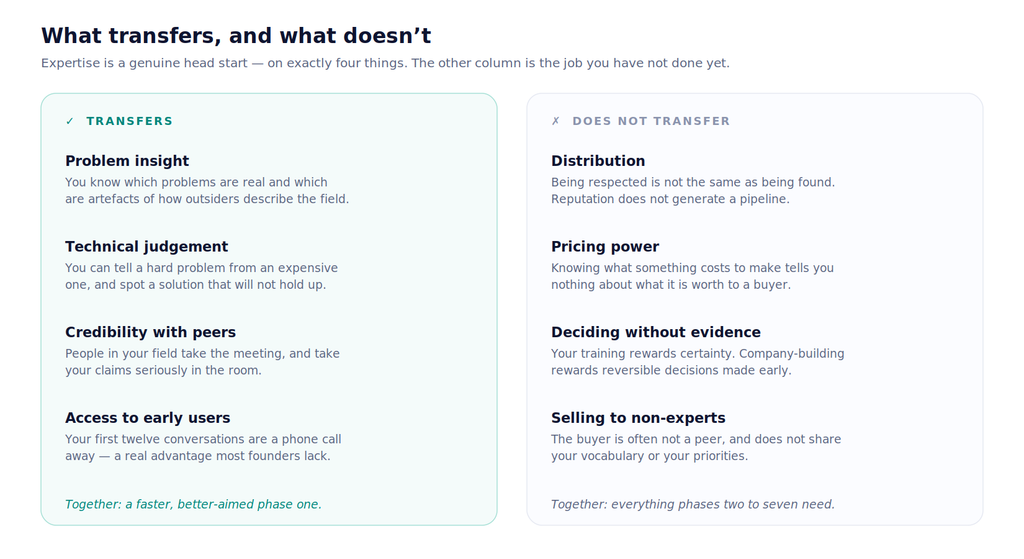
Look at where the columns fall. Everything expertise gives you is concentrated in discovery — picking the right problem, judging feasibility, getting the first twelve conversations. That is a substantial advantage, and it is why expert-founders often reach a working prototype faster than generalist teams.
Then the advantage runs out, usually somewhere around the point where the product exists and needs buyers. The skills required after that are not harder than yours. They are simply unfamiliar, and unfamiliarity in a founder tends to get rationalised as unimportance.
The curse of knowledge, and why it hits founders hardest
There is a well-documented cognitive effect behind much of this. In 1989, Colin Camerer, George Loewenstein and Martin Weber described the “curse of knowledge” in the Journal of Political Economy: people who know something find it very difficult to reason about what it is like not to know it.[1] Better-informed agents could not ignore their own knowledge when predicting how less-informed people would behave.
For a founder, this shows up in specific and costly ways:
- Your homepage is written for a colleague. The three sentences that make the value obvious to a peer make nothing obvious to a buyer.
- You skip the step that seemed trivial. The part of the workflow you stopped noticing a decade ago is often exactly where the customer’s pain lives.
- You mistake sophistication for value. The hardest part of your solution is rarely the part anyone pays for.
- You cannot hear a bad explanation. When you describe the product, your own knowledge fills the gaps in your pitch, so the pitch sounds complete to you and only to you.
The practical countermeasure is uncomfortable and cheap: have someone outside your field explain your product back to you, out loud, after hearing it once. The gap between what you said and what they repeat is your actual positioning problem.
You are not being misunderstood. You are being understood exactly as well as you explained it.
Five traps that catch expert-founders
These are not intellectual errors. Every one of them is a reasonable habit from the previous job, applied where it no longer fits.
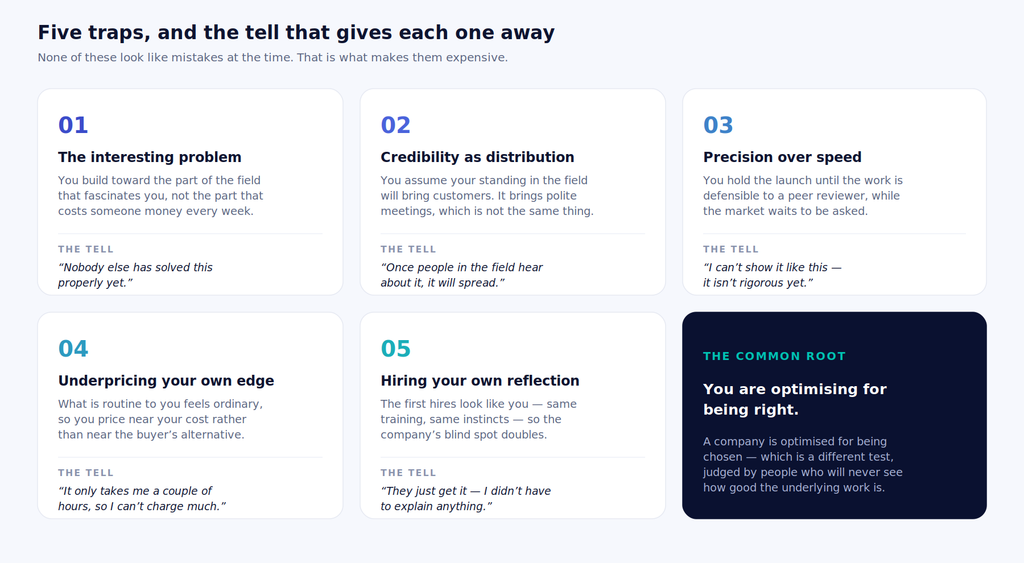
1. Building toward the interesting problem
Fields have prestige gradients. The problems that earn respect among peers are rarely the tedious, expensive, recurring ones that a business gets paid to remove. A researcher may find the boring problem beneath them precisely because everyone in the field has already agreed it is boring — which is also why nobody has fixed it.
The correction: in your customer conversations, track what people spend money and hours on, not what they find intellectually interesting. Those lists rarely overlap.
2. Treating credibility as distribution
Standing in a field opens doors, and open doors feel like traction. They are not. A respected name gets you meetings; it does not create a repeatable way for strangers to discover you, evaluate you and buy from you without a personal introduction.
This trap is dangerous because it works at first. The first ten customers arrive through your network, revenue appears, and the acquisition problem stays hidden until the network is exhausted — usually around month twelve, when it is diagnosed as a “marketing problem” and handed to an agency.
The correction: from the beginning, track which customers came from your network and which did not. If the second number stays at zero, you do not yet have a business, you have a practice.
3. Precision where speed would do
Professional training in most expert fields punishes being wrong in public. Publishing something half-finished damages a reputation built over years. Building a company inverts that: showing an incomplete thing to ten people this week is how you avoid being wrong for eighteen months in private.
The correction: separate the decisions that are reversible from the ones that are not. Reversible decisions — copy, pricing experiments, feature sequencing, positioning — should be made fast and cheaply. Save the rigour for the irreversible ones: entity structure, equity, IP, architecture.
4. Underpricing the thing you are best at
Expertise makes hard things feel easy, and things that feel easy feel wrong to charge for. So the expert-founder prices against their own effort — “it only takes me two hours” — rather than against the buyer’s alternative, which may be a six-month internal project or an ongoing loss they have quietly accepted.
This is one of the most expensive habits in the list, because early pricing anchors everything downstream: who you can afford to sell to, what margin funds acquisition, what kind of company you can build.
The correction: price against the alternative, not the input. Ask what it would cost the buyer to solve this without you — in staff time, delay, or risk — and start the conversation there.
5. Hiring your own reflection
The first hires are usually the people who were easiest to talk to during the build: same training, same instincts, same vocabulary. It feels like efficient hiring because nothing needs explaining. It is also how a company acquires a second copy of its founder’s blind spot.
The correction: the first non-technical hire — commercial, not another specialist — usually pays for itself faster than the second specialist. If your first three hires would all have been credible candidates for your old job, look hard at what the company is missing.
The three roles you have to move through
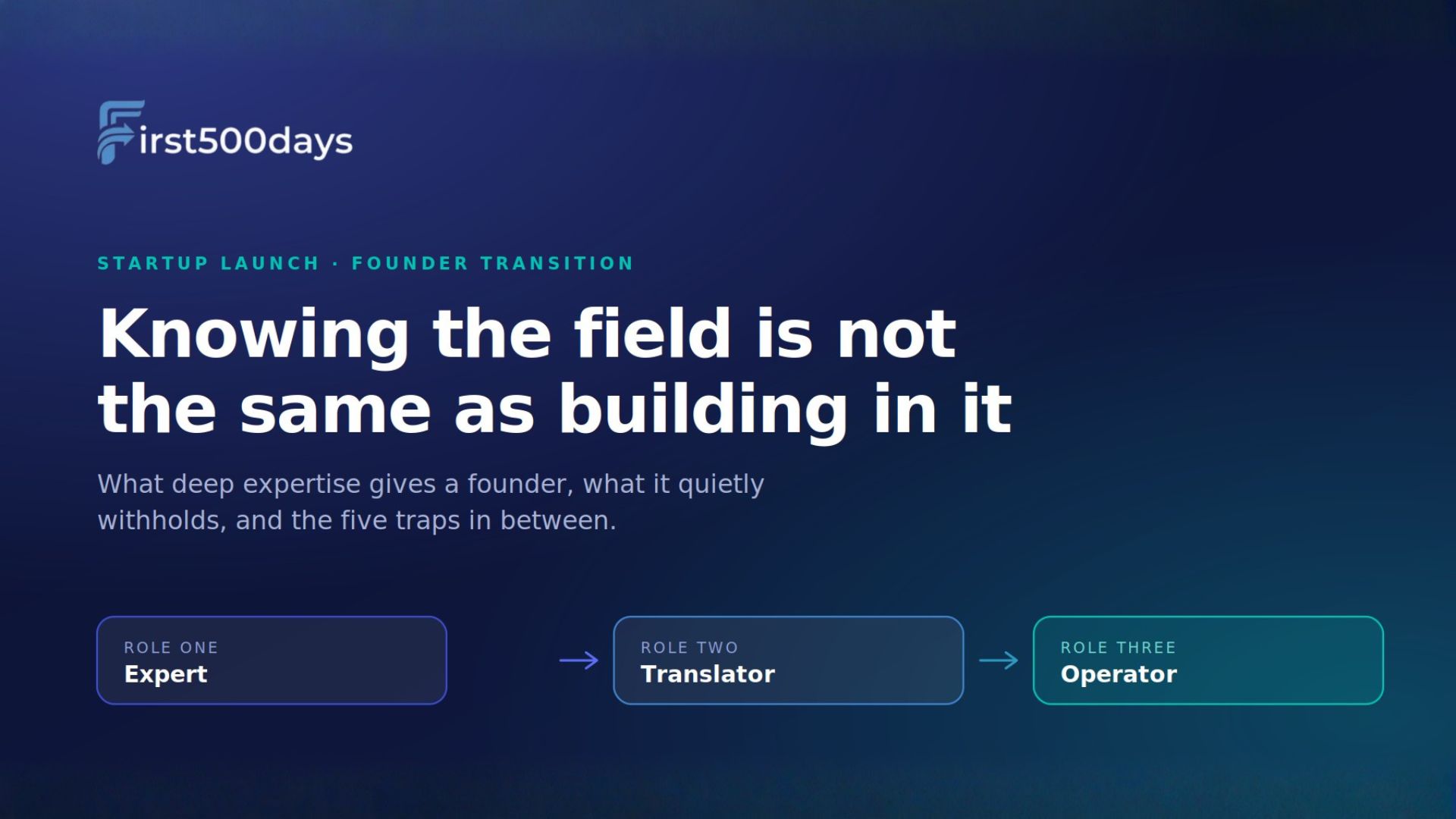
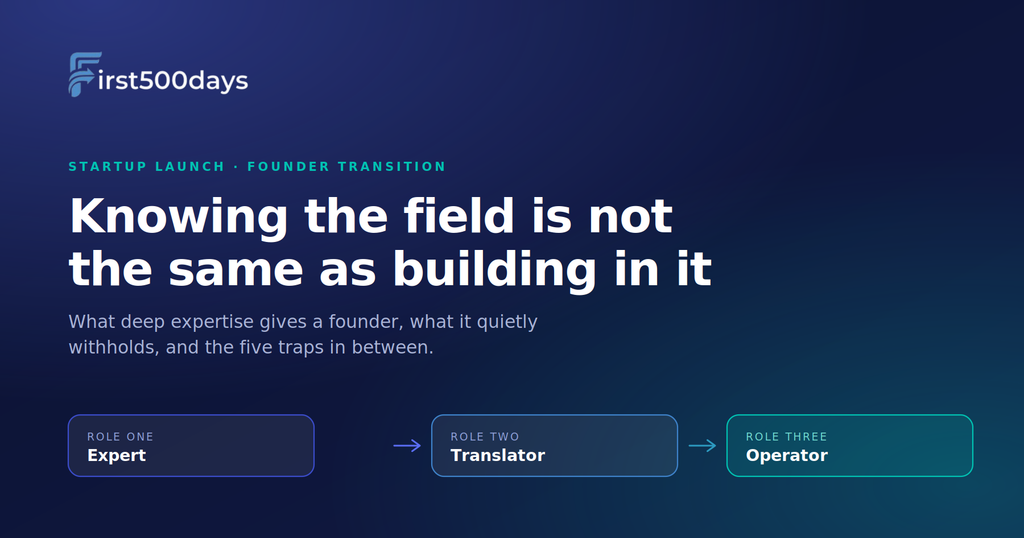
The transition is not from expert to businessperson. You keep the expertise; it stays the reason the venture is worth building. What you add are two further roles, in order.
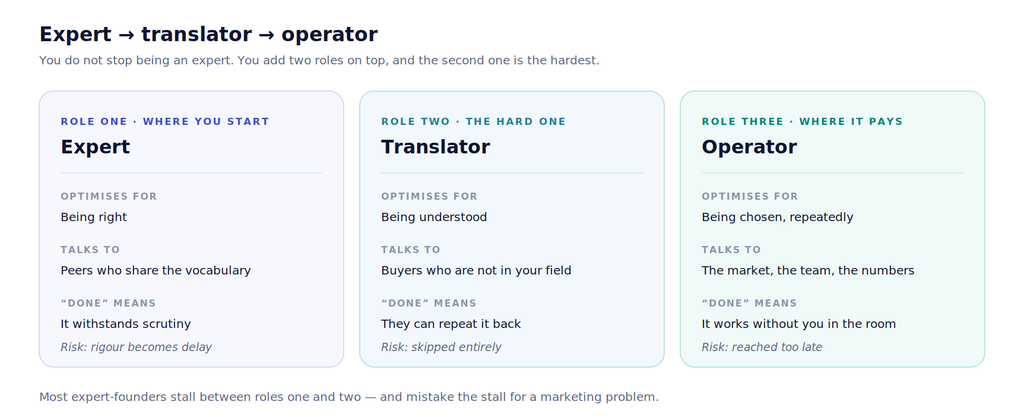
Most stalls happen in the gap between role one and role two. The symptoms are consistent: strong technical praise, weak conversion, long sales cycles that end in silence, and a growing conviction that customers do not understand what you have built. The diagnosis is usually simpler than it feels — the translation work has not been done.
What to do differently in your first 100 days
Concrete adjustments that cost nothing and change the trajectory.
- Interview outside your peer group. Half your customer conversations should be with people who are not experts — the person who signs the invoice is often not the person who understands the technology.
- Ban your own vocabulary for a week. Write the description of what you do without a single term of art. If it becomes impossible to describe, the positioning is not finished.
- Set a “show it early” date. Pick a date, in writing, before which the product will be shown to ten outsiders regardless of state. Precision has a deadline now.
- Write down the price before you are asked. Deciding under pressure in a live conversation produces a discount every time.
- Find your commercial counterweight. A co-founder, an early hire or an external partner whose instincts differ from yours — and whose disagreement you have agreed in advance to take seriously.
- Track network vs non-network customers from day one. One column in a spreadsheet, and it will tell you the truth about distribution before the network runs out.
The pattern we see most
Expert-founders reach a working product faster than almost anyone, then spend twice as long as they expected getting from product to repeatable revenue. The build was never the constraint. Recognising that early is worth more than any single piece of tactical advice in this article.
When to bring in a partner — and when not to
Not every expert needs a co-founder or an outside venture partner. Some indicators are genuinely diagnostic.
Bring someone in when: customers who did not come from your network are close to zero after several months; you have said “they just don’t get it” more than twice; the price has never been tested against a real buyer; or you are the only person who can close a sale, explain the product, or make a decision.
Do not bring someone in when: you have not yet had twelve customer conversations of your own — nobody can commercialise a problem you have not defined; or when what you actually want is validation rather than a counterweight. A partner who agrees with you is an expensive mirror.
And a caution about the obvious solution: hiring a salesperson before you personally understand why people buy is one of the more common ways to burn a year. The founder has to close the first customers, badly, before anyone else can close them well.